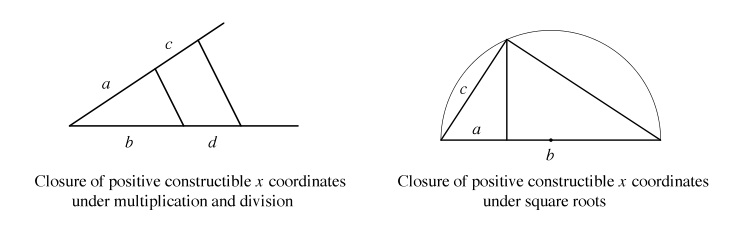
As explained in detail by Anthony Knapp in his book Basic Algebra (Digital Second Edition, 2016), classical Euclidean geometry emphasized constructions in the Euclidean plane that could be made by straightedge and compass.
Allowable constructions are the following:
- to form the line through two distinct points
- to form a circle with a given center and radius
- to form the line through a given point different from finitely many other lines through that point
- to form a circle with a given center and a radius different from that of finitely many other circles through the point
Intersections of a line or a circle with previous lines and circles establish new points for continuing the construction.
Four notable problems remained unsolved in antiquity:
[1] how to double a cube, i.e., how to construct the side of a cube of double the volume of a given cube
[2] how to trisect any constructible angle, i.e., how to divide the angle into three equal parts by means of constructed lines
[3] how to square a circle, i.e., how to construct the side of a square whose area equals that of a given disk
[4] how to construct a regular polygon with n sides (n-gon) and outer radius 1
Geometers in antiquity did not yet have at their disposal tools that would allow them to reach a conclusion about these subjects. Those tools would be developed during centuries into what we today call modern (or abstract) algebra.
More specifically,
[1], [2] elementary field theory proves that doubling a cube and trisecting a 60-degree angle are impossible with straightedge and compass
[3] the proof of the impossibility of squaring the circle can be reduced to a proof that the number π is transcendental over the field of rational numbers
[4] Euclid showed that a construction is possible for n = 5, but only with the German mathematician Carl Friedrich Gauss the question of for what values of n can a regular n-gon be constructed with straightedge and compass was settled: a regular n-gon is constructible with straightedge and compass if and only if n is the product of distinct Fermat primes and also a power of 2. Gauss used results previously obtained from Fermat and Galois to achieve this result.
What does this have to do with management, that is, the way people perform work in organizations?
Your organization constantly re-learns the same things over and over again because of two main reasons:
[5] the resident expertise floats inside the heads of a few “gurus”
[6] it lacks the operational understanding of how to sustainably transition between states
The big problem with this is that your organization is still working in its antiquity, its still on level 1 of the game. A clear diagnostic for this is the degree to which your employees understand what they are doing and how they are doing it.
Modern algebra today operates at level 99999 of the game and running into 100000 — but doing algebra today is not necessarily more difficult than it was in ancient Greece.
While you are still operating at level 1, 2 or at best 3 and struggling to keep up.
Sometimes thousands of results were indirectly needed to prove a modern algebra proposition, such as those mentioned above.
Point [5] is related with the importance of a single source of truth and also with the inneficiencies that come with dependencies between people. Remember this in conjunction with [6] when somebody tells you that you are not supposed to waste your time with documentation. What if you had to ask Euclides or Fermat for a result he did not care to properly document? What would it be like if Euler wanted to keep his knowledge in his precious head alone?
Point [6] is the cornerstone of evolution, because it deals with how to develop knowledge in a scientific way, so as to split a complex problem that may even take centuries to solve, into more manageable problems that you can address with variations of the tools you possess, over time. It is at the core of the Study phase in the PDSA cycle, but here we are looking at it from a chain of cycles perspective.
Something that usually puzzles peope in mathematics is that they are used to operate on an immediate logical frame, that is, they can easily derive a direct conclusion from a given set of assumptions, but they usually do not go beyond that to 2nd or higher orders of implications. So when they look at a mathematical result they struggle because that result is based on assumptions which they do not understand and this is counterintuitive to their usual modus operandi.
The thing that we need to understand about mathematics is that we only care about the most simple way of achieveing a result. We do not and cannot afford to prove the entire mathematical body of knowledge everytime a result has to be proven. So the only thing we do is to choose the set of appropriate assumptions and derive the results from them using an appropriate choice of transformations, which are themselves also not proved. We assume everything else besides our result is true without proof.
But of course this only works if the same procedure was applied in obtaining those assumptions as results. And this can be checked if you wish so. And this is how knowledge is developed in a scientific way.
This is how you get from straightedge and compass into results that are universaly applicable.
Remember this the next time someone tells you that everybody in your organization has to work in a single specific way and that way should not change.
They did it with Scrum 25 years ago and the result is that today you are still managing product development with a ruler and compass when you could in fact already be doing advanced algebra. But you chose to let 25 years of knowledge and potential improvement pass you by untapped.