Here’s where the comedy begins.
Alfred Cromwell
Those who most loudly claim their superiority on account of their credentials are often the people who have most carefully avoided the risks that produce greatness.
Have they endured years of structured, proper thoughts?
Have they ever stood alone with an idea that is un-yielding, that refuses to bend to the consensus?
Have they pursued it where it led no matter the consequences?
The tragedy is not that such people exist, but that they have been mistaken for people who should be taken seriously.
That is what should bother you if you are a free thinker.
Author: mariofvicente
Genesis
The first thing that came to existence should by definition have been single, since it was the outcome of the first change that ever happened.
Because it came to existence from nothing, it had to contain the principle of change in itself, since change is an attribute and not an object.
Therefore the first thing changed.
Once change created quantity, the first system was born.
The first system generated new things which in turn generated new systems.
This process still happens today. In fact, it is the only thing that has ever happened.
Therefore, still today new things can be generated out of nothing like their own kind.
At any moment, a system can be created like no other before it.
This music captures that moment when the Genesis change is about to take place.
When interacting components are about to create a new system and the Creation takes place again.
The sand cat
Real growth often happens in silence.
Strength is built in patience.
Do it like the sand cat — and you will call the desert your home.
The Magician
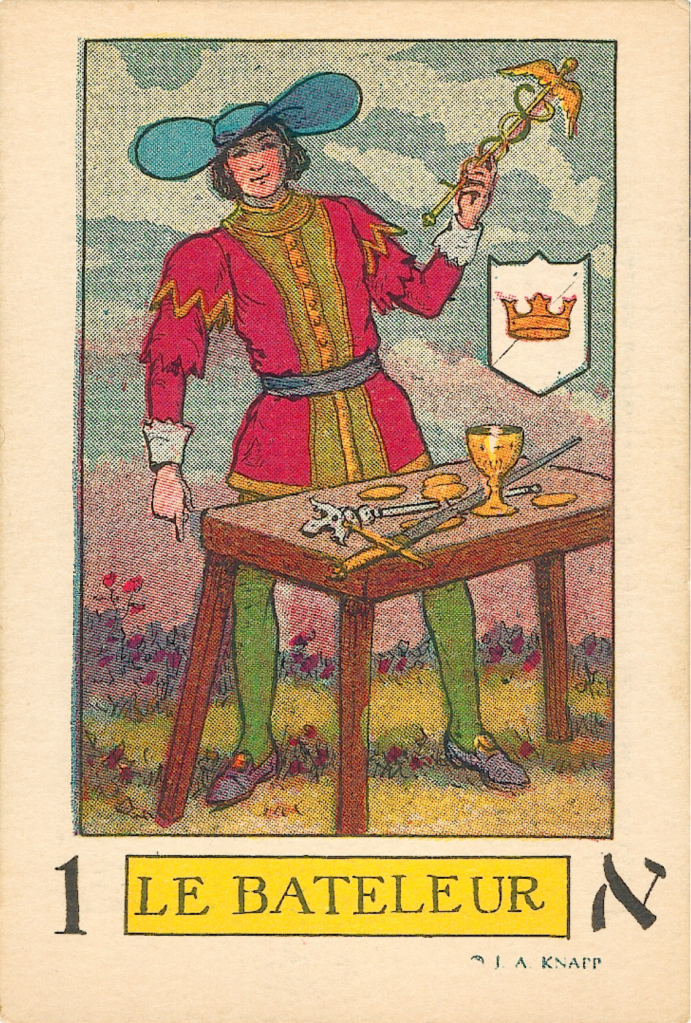
The modern depictions of the magician are too explicit. Earlier renditions were more instructive. You see, the magician was portrayed as a trickster, entertaining kids or amused adults. This is what regular people see. They look at the magician’s dexterity with so many things and they take it as a narrow capability split between stuff. He does fancy stuff with this, he does fancy stuff with that, and you are entertained. They look at it as if looking at each hand alone in a piano performance for two hands.
But what only adepts understand is that the magician operates at a system’s level. Its about the interactions between those different things, a whole greater than the sum of its parts. In order to understand this character you need to imagine the system behind all that fancy stuff. Imagine a system in which you can do as you please with so many different assets, even if they are new to you.
That’s what’s really going on. The rest is entertainment.
Remember when you did something for the first time? Do it like a pro and you will have achieved the summit of this pyramid. And if you are a pro at doing things for the first time its because you started as a pro at starting things — you started as The Fool.
The card is No.1 and its the first lesson to the Fool not because it is of lesser value but because it is the compass for the journey, and a compass that points to itself as a destination. The beginning and the end is card No1. The Fool is the start of every Magician and the Magician is the Anti-Fool, or the Fool at the end of his journey.
The mathematics of change
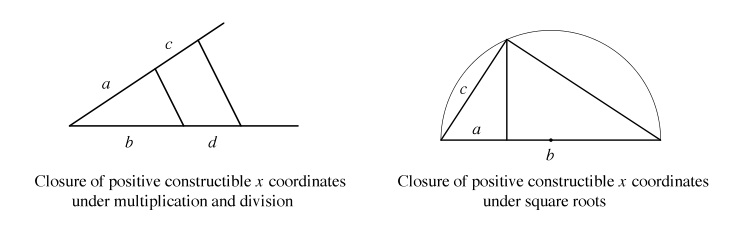
As explained in detail by Anthony Knapp in his book Basic Algebra (Digital Second Edition, 2016), classical Euclidean geometry emphasized constructions in the Euclidean plane that could be made by straightedge and compass.
Allowable constructions are the following:
- to form the line through two distinct points
- to form a circle with a given center and radius
- to form the line through a given point different from finitely many other lines through that point
- to form a circle with a given center and a radius different from that of finitely many other circles through the point
Intersections of a line or a circle with previous lines and circles establish new points for continuing the construction.
Four notable problems remained unsolved in antiquity:
[1] how to double a cube, i.e., how to construct the side of a cube of double the volume of a given cube
[2] how to trisect any constructible angle, i.e., how to divide the angle into three equal parts by means of constructed lines
[3] how to square a circle, i.e., how to construct the side of a square whose area equals that of a given disk
[4] how to construct a regular polygon with n sides (n-gon) and outer radius 1
Geometers in antiquity did not yet have at their disposal tools that would allow them to reach a conclusion about these subjects. Those tools would be developed during centuries into what we today call modern (or abstract) algebra.
More specifically,
[1], [2] elementary field theory proves that doubling a cube and trisecting a 60-degree angle are impossible with straightedge and compass
[3] the proof of the impossibility of squaring the circle can be reduced to a proof that the number π is transcendental over the field of rational numbers
[4] Euclid showed that a construction is possible for n = 5, but only with the German mathematician Carl Friedrich Gauss the question of for what values of n can a regular n-gon be constructed with straightedge and compass was settled: a regular n-gon is constructible with straightedge and compass if and only if n is the product of distinct Fermat primes and also a power of 2. Gauss used results previously obtained from Fermat and Galois to achieve this result.
What does this have to do with management, that is, the way people perform work in organizations?
Your organization constantly re-learns the same things over and over again because of two main reasons:
[5] the resident expertise floats inside the heads of a few “gurus”
[6] it lacks the operational understanding of how to sustainably transition between states
The big problem with this is that your organization is still working in its antiquity, its still on level 1 of the game. A clear diagnostic for this is the degree to which your employees understand what they are doing and how they are doing it.
Modern algebra today operates at level 99999 of the game and running into 100000 — but doing algebra today is not necessarily more difficult than it was in ancient Greece.
While you are still operating at level 1, 2 or at best 3 and struggling to keep up.
Sometimes thousands of results were indirectly needed to prove a modern algebra proposition, such as those mentioned above.
Point [5] is related with the importance of a single source of truth and also with the inneficiencies that come with dependencies between people. Remember this in conjunction with [6] when somebody tells you that you are not supposed to waste your time with documentation. What if you had to ask Euclides or Fermat for a result he did not care to properly document? What would it be like if Euler wanted to keep his knowledge in his precious head alone?
Point [6] is the cornerstone of evolution, because it deals with how to develop knowledge in a scientific way, so as to split a complex problem that may even take centuries to solve, into more manageable problems that you can address with variations of the tools you possess, over time. It is at the core of the Study phase in the PDSA cycle, but here we are looking at it from a chain of cycles perspective.
Something that usually puzzles peope in mathematics is that they are used to operate on an immediate logical frame, that is, they can easily derive a direct conclusion from a given set of assumptions, but they usually do not go beyond that to 2nd or higher orders of implications. So when they look at a mathematical result they struggle because that result is based on assumptions which they do not understand and this is counterintuitive to their usual modus operandi.
The thing that we need to understand about mathematics is that we only care about the most simple way of achieveing a result. We do not and cannot afford to prove the entire mathematical body of knowledge everytime a result has to be proven. So the only thing we do is to choose the set of appropriate assumptions and derive the results from them using an appropriate choice of transformations, which are themselves also not proved. We assume everything else besides our result is true without proof.
But of course this only works if the same procedure was applied in obtaining those assumptions as results. And this can be checked if you wish so. And this is how knowledge is developed in a scientific way.
This is how you get from straightedge and compass into results that are universaly applicable.
Remember this the next time someone tells you that everybody in your organization has to work in a single specific way and that way should not change.
They did it with Scrum 25 years ago and the result is that today you are still managing product development with a ruler and compass when you could in fact already be doing advanced algebra. But you chose to let 25 years of knowledge and potential improvement pass you by untapped.
The Annunciation, Praeludium
This is the reason why I decided to start learning the violin more than 7 years ago.
These sixteen H.I.F. Biber’s Sonatas are to me the greatest musical piece of Art ever.
They are the beginning and the end of my violin journey.
Much room to improve here but I am just getting started.
Altas Qualificações
A Ana acabou de obter o mestrado.
A Ana esteve os últimos 5 anos a estudar Psicologia.
A Ana tem tantas qualificações fora da Psicologia como eu que sou analista de negócio.
Se eu disser o contrário à Ana (premissa), o que lhe estou a dizer é que o que ela esteve 5 anos a fazer numa faculdade é-me completamente irrelevante. Esteve a tratar de Psicologia como podia ter estado a tratar de Engenharia do Papel, que para mim seria exatamente o mesmo. Com o mesmo critério também podia ter estado a fazer rigorosamente nada durante 5 anos porque para o efeito “qualquer coisa” e “nada” têm a mesma aplicabilidade.
Ou seja, estou a dizer à Ana que ela não tem quaisquer qualificações reais fora da Psicologia. Se isto é verdade, então a premissa é falsa, e vice-versa.
Eu conheci o André no open space de uma consultora IT.
O André tinha acabado de sair da sua faculdade onde se licenciou em Engenharia Química e estava a fazer uma formação em RPA (robot process automation) dada pela consultora.
O André ia começar a exercer a função de programador RPA. Naturalmente, essa formação apenas lhe garantia os mínimos para começar a exercer pelo que na realidade a formação do André iria ser on-the-job nos próximos meses ou mesmo anos, dependendo do tipo de desafios que lhe viessem a ser colocados. A única razão pela qual o André estava a ter formação era por não ter à data as competências requeridas para a função.
Por definição, no lugar do André podia estar a Ana ou a Marta ou o Gustavo.
Por definição, o André podia ter qualificações em Matemática, Jornalismo ou Medicina Tradicional Chinesa.
Uma função que pode ser desempenhada por uma pessoa com qualificação em qualquer área é por definição uma função não qualificada. Porque é uma função sem vínculo à qualificação da pessoa.
Logo, o André exerce uma função não qualificada, para a qual portanto as qualificações dos candidatos são irrelevantes.
A Mariana formou-se em Direito e trabalha como jurista na sua entidade empregadora (ou seja atua como advogada do empregador). A Mariana desempenha portanto uma função qualificada.
A conclusão óbvia é que é absolutamente inconsequente considerar as qualificações dos recursos sem considerar a área a que essas qualificações dizem respeito.
O especialista é por definição a pessoa que exerce uma função qualificada. Os restantes (generalistas) são perfis não qualificados. Precisamente porque nós não podíamos estar menos preocupados com em que é que eles se qualificaram exatamente ou sequer se se qualificaram.
Eu estudo violino há mais de 7 anos. Violinista é uma função qualificada.
Se por acaso estão a pensar «Ah mas o que a Ana esteve 5 anos a fazer na faculdade é importante porque pode ter desenvolvido ‘transferable skills’.» eu digo exatamente. Concordo. Mas isso concorda com o que está escrito acima porque é outra forma de dizer que a qualificação académica da Ana só por si, sem considerar o currículo académico, não nos diz nada sobre a aptidão dela para funções fora da Psicologia. Tal como o facto de o André ser licenciado em Engenharia Química dizer nada sobre a aptidão para programar RPA. Ou seja, é o currículo académico e não a qualificação que nos interessa, para temas fora da Psicologia. O Mestrado da Ana não nos permite só por si afirmar que ela está qualificada para o que quer que não seja exercer Psicologia. Eu só posso afirmar o contrário disto se desconsiderar por completo o que ela esteve 5 anos a fazer (porque ela não pode ter estado 5 anos a preparar-se para tudo), caso em que ainda por cima vou deixar de a poder comparar com outros candidatos à mesma função, porque passam todos a ser igualmente “aptos” o que não faz qualquer sentido porque é contrário ao meu objetivo de aferir a aptidão da Ana fora da Psicologia.
Quanto mais elevado o grau académico, mais importante se torna saber tudo isto. Porque como toda gente já sabe, a carreira académica é uma especialização gradual, não é uma generalização. Um doutorado especializou-se ainda mais numa área científica concreta do que um mestrado, e este do que um licenciado. Um doutorado em inteligência artificial tem tantas qualificações como um licenciado em engenharia informática para administração de sistemas informáticos. Mas se falarmos de reconhecimento facial ou interfaces homem-máquina, já é o contrário. E se falarmos de psicologia, estão exatamente ao mesmo nível que é “inapto”.
Mais uma vez, o diferenciador é o currículo e não a qualificação, que só tende a ter aplicação mais restrita quanto maior for o seu nível. Mais uma vez, desconsiderar o que as pessoas estiveram a fazer durante vários anos no seu percurso académico é contrário a todos os objetivos da indústria.
Projetos falhados
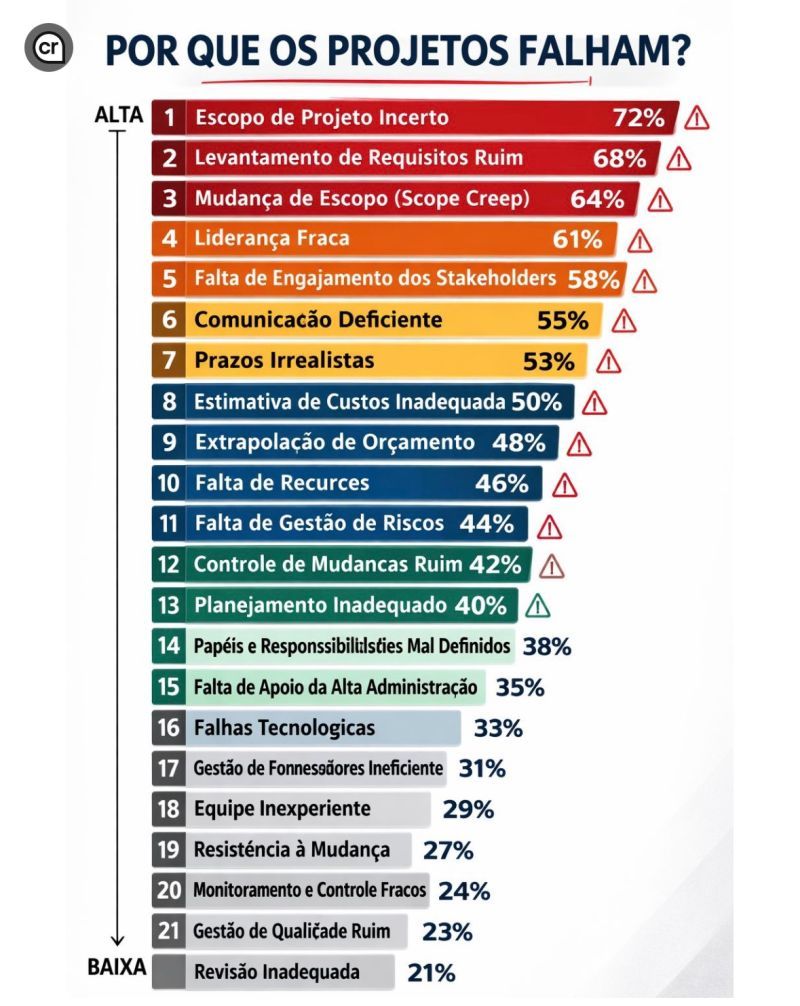
Aqui está a única via pela qual os business analysts dão retorno do investimento aos clientes. Não é por produzirmos deliverables sofisticados que o cliente pode vender mas sim por facilitarmos o investimento nas coisas certas e a execução enxuta. Um só analista de negócio experiente é suficiente para garantir o alinhamento entre dezenas de pessoas numa iniciativa de grande âmbito.
Aqui está porque é que não vai ser a última grande fad tecnológica ou receita de gestão que vai resolver os problemas nos projetos.
Os business analysts são “só” os responsáveis primários pelos fatores que sempre estiveram no topo desta lista. Os gestores de projeto são accountable mas os BAs são responsible por esses fatores. Essa é a razão pela qual os business analysts são os profissionais melhor posicionados para gestão de projeto bem sucedida, de entre aqueles vindos de outras funções.
Desde a década de 90 que se sabe que isto é assim:
– Chaos Report (Standish Group, 1995)
– Canada Survey (KPMG, 1997)
– Return on Investment from More Effective Requirements Management (American Programmer magazine, 1997)
– Insights into Software Project Management (Proceedings of the Applications of Software Measurement Conference, 1999)
Todos estes estudos independentes concordaram com a tabela acima.
Aqueles que ainda hoje defendem que os BAs perdem o tempo deles em vão a documentar o negócio (e o mesmo vale para a documentação técnica pelos developers), demonstram não só não saber o que é gestão de projeto como também não saber o que é análise de negócio. Como é impossível criar documentação nova sem analisar o tema que é documentado, é impossível afirmar que gerir artefactos de âmbito de projeto não é fazer análise de negócio (já quanto à qualidade dessa documentação, isso é outro assunto). Quem assim pensa não se lembra que a única maneira de provar que sabia o que quer que fosse quando estava na sua faculdade de referência, era documentando o que sabia. Porque será?
Aqueles que acham que só precisam de user stories para fazer “agile” demonstram total desconhecimento de gestão agile porque não sabem que o agile que preconizam foi criado há 25 anos, e apenas para gerir uma equipa de developers (e uma apenas, não várias). Por isso é que não precisam de mais nada a não ser user stories. Mas acima do âmbito dessa equipa existem outras equipas com dependências entre si, existe uma gestão de produto e de portfolio, existe uma estratégia organizacional, que para servir de alguma coisa para as centenas e às vezes milhares de pessoas que trabalham nos value streams, necessita dos seus próprios artefactos.
Por isto é que no Disciplined Agile do PMI, a moeda de câmbio para a optimização do fluxo de valor à escala empresarial é um artefacto que documenta o âmbito que se quer atingir (e mais qualquer coisa).
Quem não sabe isto não sabe gestão. Não há outra forma de dizer o óbvio.
O leitor inteligente poderia perguntar: se os business analysts são os responsáveis primários pelos fatores que sempre estiveram no topo desta lista, então isso não quer dizer que os BAs são os principais responsáveis por projetos falhados? A resposta a isto é dupla: por um lado é verdade que há BAs que não sabem que têm esta responsabilidade ou que não são competentes, por outro e relacionado com isto temos o principal fator causal de projetos falhados, a causa destas causas — gestores de projeto que não fazem gestão de projeto. Mas fazem política, fazem o bidding do sponsor, posam para a fotografia… pelo menos até que o produto é entregue e as pessoas começam a utilizá-lo e mantê-lo.
Quando eu há uns anos fiz entrevistas de validação técnica de BAs, vários dos cenários que eu lhes colocava eram destinados a perceber como é que o BA via o seu papel como BA e o seu nível de responsabilidade. A maioria deles, quando questionado sobre conflitos entre o seu papel e diretivas do gestor de projeto, responderam que fariam o que o gestor de projeto lhes mandava fazer. Ora para isso os nossos clientes não precisam de gastar o dinheiro deles com BAs… e claro que depois vão gastar muito mais sem eles.
Stairway to Heaven

The perception of uniqueness
The new approach for true machine cognition is a dynamic and generative geometric system with mathematical precision.
It doesn’t guess; it just works. Every time.
Whatever you do, you invariably realize that you are something that just works. Every time. That is one of the things that gives you the perception of “uniqueness” or “specialty” (along with the fact that you cannot be defined by what you work “on”). Its that you always work. Always and whenever.
But that perception is something a posteriori relative to that “thing” that works. Get the point? You can only get it… because you work.
 Compliments of the Author