The pyramid

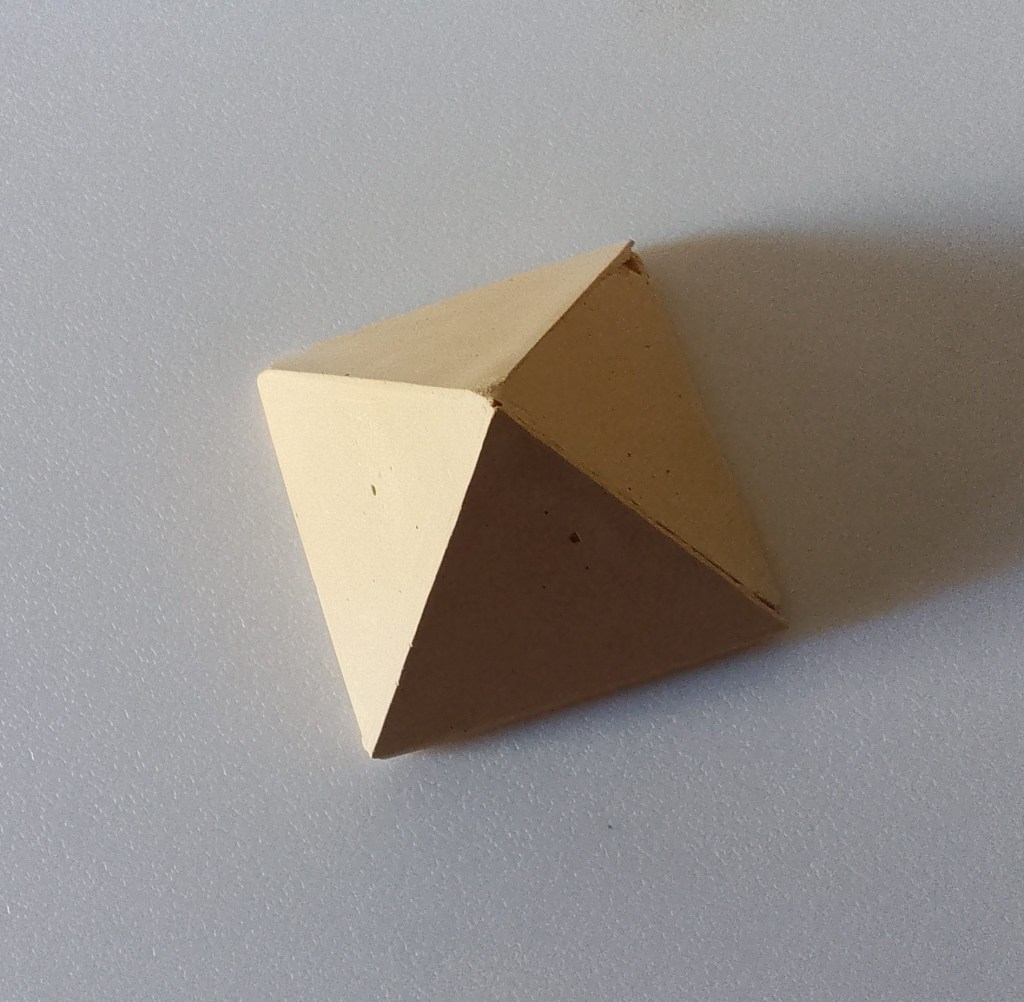
I have built a pyramid from scratch.
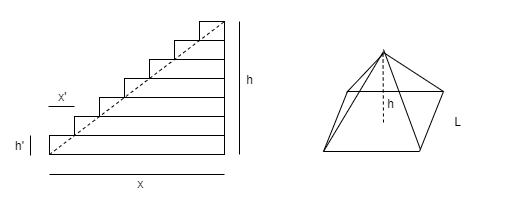
Starting from the height of the blocks (0.5 cm) and the desired width of the base (7.5 cm) and height (5.5 cm) of the pyramid, I computed the width offset between layers and with it the 2D dimensions of the blocks in each layer.
I used 48 blocks with different dimensions stacked in 9 layers.

The calculations are as follows:
h’ divides h in as many parts as x’ divides x.
Therefore, h = k h’ and x = k x’ with k natural and equal to the number of blocks in height.
Therefore, x’ = x / k = x h’ / h.
In a pyramid, the base side will be L = 2x, so x’ = L h’ / (2 h).
The width of the n-th layer will be L(n) = L – 2 x’ n.

The dimensions of the block in each layer depend on the architecture which I chose to be such as to preserve the maximum number of blocks with their original standard dimension which is 2.5 x 2.5 cm. This architecture gives 3 types of blocks which are the standard one, the one with one dimension dependant on the layer and another one with both dimensions dependant on the layer.

I made the blocks with air dry clay and I used white cement and ocher yellow powder for the external cover.

True Machine Learning

While the Medieval Age of engineering feasted on the misinformation and disinformation about machine learning and artificial intelligence, I have been addressing the real problems.

Today true machine learning is born.

Today the Dark Age on this subject has passed.

True Artificial Intelligence is now being woven, a beautiful child that will come forth from the thoughtful and artistic womb of dutyful posterity.

For a context about this subject please refer to my 2019 article, since my position hasn’t changed since then. You also benefit from reading this other article.

The presentation, without the demonstration, can be downloaded here.

The communications to the Portuguese Instituto Nacional da Propriedade Industrial, the European Patent Office and the United States Patent and Trademark Office can be accessed by clicking on the respective links.

presentation
demonstration

You can watch the videos above on Rumble:
True Machine Learning
True Machine Learning – Demonstration

March 2025 Update:
This model became the basis for a proper, scientific machine model of Reasoning which is described here.

____________
Header image: citological drawing by Ramon y Cajal.

Leadership and a Violin

The process of developing new skills while we are already mature enough to assess that development itself may lend to an infinite loop of added value. You are challenged. You adjust yourself. You explore the challenge by relating it with previous experiences. You map the universe you know to the new reality.
The effort is crowned when you discover what it means to have learned something new towards other dimensions in which you are still developing.

What can this mean in the context of ______?
What have I learned about this that can help me navigate ______?

This article illustrates this point – that you can exponentialize your learning by assessing your learning process itself and by devising its potential applications.

Leading with the right hand

The right hand sets and keeps the strings in motion by passing the bow hairs over them. Because the hairs are powdered with rosin, this friction energizes the strings. Each string will vibrate at a specific frequency at any given situation, depending on the tension at rest, the vibrating length and type of string (each string is different in the way it is built or the material used).

In what concerns the right hand, this frequency is not determined by the violinist.

In the most simple case, in which we do not want to add ornaments to the notes (intensity, tonality, chromatism, etc, which we collectively term embelishments), the role of the right hand relative to the string being played is merely to set it in motion and keep it doing so for the duration of the note. Because we want the natural sound, we want to let the strings vibrate at their natural frequency.

The right hand will be imposing nothing more on the string than merely the mimimum friction to keep it vibrating.

Anything else we add to this, relative to the string, will change its natural sound; it will either be an ornament or a deviation from the intended sound.
Its also up to the right hand to choose the string being played.
These two roles mean that the right hand will be changing its position to set the bow angle to tackle the right string, and it will be varying speed depending on the time value of each note. Regarding the angle of the bow relative to the violin, there is a very limited degree of freedom between adjacent strings, and transitioning between non-adjacent strings requires a precise knowledge about this range a priori.
Changes in speed of the bow are especially relevant when also changing direction of stroke or crossing strings, in which case a similar situation occurs as when starting the first note (at the beggining of the music or after a pause).

Start with the miminum effort to set the strings in motion and only right after concern yourself with setting the right speed of the bow.

For this you start by moving not your arm, but just your fingers or in an even smallest degree your wrist.
So there are two key attributes of the right hand leadership at play here, which it is very easy to conflict with each other when learning:

  • precision
  • smoothness

You know precisely what your movements will be just before executing them, but that intentionality and precision are put in place with the minimum stress on the strings.
I use mental frames to set me up for doing things in specific ways, such as in this case. I picture my hand resting on the bow at all times, not commanding it. To get a notion of what it is, rest your forearm in some surface where your hand and wrist will be free to move. You hand will drop below the line of your forearm and your fingers will be slightly curved towards your thumb.Now place a pencil between the thumb and the other fingers, grab it with the tips of your fingers and they will almost exactly land in the usual relative positions violinists hold the bow.

The most confortable, natural and effortless disposition will produce the best approximation to the proverbial “pure and singing tone”.

This is a principle that guides formal composition and transcription as well, because there are countless ways a given sequence of notes can be played, and all decisions in this respect should place the musician in the most natural position for execution:

  • the notes can be played in separate dedicated bow strokes or in the same one (legato);
  • the same note can be played in different strings (with different fingerings);
  • the difficulty of added ornaments may depend on combinations of the previous two factors.

Leading with the left hand

The left hand sets the vibrating length of the strings, by pressing them with the fingertips against the fingerboard, which in turn determines the exact frequency of the sound produced when playing, along with the tension of the string at rest and the type of string.
The key attributes of the left hand leadership are

  • strenght
  • anticipation

The finger has to fix the extremity of the vibrating string acting like a small hammer for the duration of the note. Less pressure than that will slow the intended frequency of the note for allowing more freedom of movement to the string and will sound the same as a muffled lower pitch note.

This attribute of the left hand contrasts with the right hand, as you may have noticed already, and that is an added difficulty when learning because the two hands behave very differently but in precise concert with each other.
As for the anticipation, it is two-fold

  • The left hand executes before the right hand
  • The available left fingers anticipate the next notes

This means that the bow plays on a string which is already stopped by a left hand finger and that, while playing a note, the next notes should be anticipated whenever possible so that this principle is applied for two consecutive notes. That is, while playing a given note, if the next fingers you will be using are available, place them over the strings before you need them. This may lead you to play on a finger while having up to three other fingers already in place (most probable if the notes are very short in duration). This in turn will allow you to focus more on the bow between notes, which is specifically useful when crossing strings.


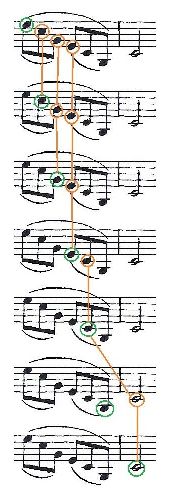
In this image you can see the same sequence of notes in time, the notes stopped already by the left hand fingers in waiting (orange) while the green note is being played.

Without the left hand leadership, a melody is played in a succession of disconnected individual notes, and these will start with a delay between them making the start pitch of the note always lower than its final one. On the opposite, provided that all other factors are adequately accounted for, the 2nd dimension is what glues everything together into a natural performance, much like water flowing in a stream, because

it sets the stage for reducing the overall effort of playing.

So there you have it:

  • precision
  • smoothness
  • strenght
  • anticipation

Alexander Markov’s beautiful performance puts it all together in this excerpt ending with a timely advice on the subject [1].

[1] Alexander Markov plays Paganini’s 24th Caprice, an excerpt from ref [2], and talks about violin practice from ref [3]
[2] https://www.youtube.com/watch?v3DaGGPEDWQA5A
[3] https://www.youtube.com/watch?v3DNSoWTWXoIwY

____________
This article was originaly published on LinkedIn at August 10, 2021.

Motivation

Suggested listening:

When I am in the sea I seldom focus on the people there. For obvious reasons. There everything happens at the rythm of the waves, of the sets of waves and of the tides. Its not about people there. People are the aliens in there. For that reason, and because of a couple more reasons that I will illustrate here, I rarely give advice to anyone there. Despite having lost count of the time I spent there.
One day the setting was inviting some sort of meditation. Small waves. Long wait between sets. Many people there learning the job. I spent some time waching them. After all this time it is straightforward to spot what’s going on in the people’s minds there, in general and most particularly if they are below a more or less arbitray degree of proficiency. You see the ones that are confident. Or uneasy. Or affraid. Or angry. Or whatever. The body posture, the face, the positioning in the lineup and on the board. They don’t lie.
There was a person there who stood much time still, hands grabbing the board, nervously looking at the horizon, each wave a decision proof. The decision fled away into perceived safety everytime.
At some point I focused on the coming set, after a thought I told her – this wave is going to be a good one.
She looked at me apparently making sure I was talking to her, then looked at the wave summoning in her direction.
She looks again at me, this time her eyes were lit up in confidence, she positions herself with the most hardworking focused posture – the complete opposite of a minute before – and starts to paddle. I thought to myself ‘not sure how this is going to end but let us see’.
She stood up and glided the wave.
I felt relief because it proved my assessment of the situation, despite knowing fully well how easy it is by now for me to anticipate the behavior of a coming wave. She then thanked me and I got on with my usual affairs.
There are these two things, at least, to take into account when you want to motivate someone.

  • did you assess the goal you are motivating people into?
  • did you assess the circumstances of the people you are addressing?

My bet here was in the match between the situation and the person. If your advice fails to bear fruit, won’t it erode confidence in others? Can you really motivate someone without that knowledge? Without it, motivationals are just… empty words.

____________
This article was originaly posted on LinkedIn at March 2, 2019.

Systems Thinking. Why?

Suppose we are to assemble a team for important tasks. We want the best to do the best. Therefore, we gather

  • a very good computer engineer
  • a very good project manager
  • a very good analyst

It is important that they are good at what they do, because they will be facing challenges in their field and we want to make sure they follow the best practices for the known problems and deal proficiently with the unknowns. What do you expect to happen later on? The project should be a success, shouldn’t it? After all, the expected challenges were dealt with and the unexpected were tackled in the best possible way.
If you wondered, while thinking about this brightful scenario, that something is missing in this picture, you may be already thinking in a systems perspective.
What’s missing here is

What are those very good people working for exactly?

The matter is not what they are doing. We know already that

  • the computer engineer should be making good engineering
  • the project manager should be doing good management
  • the analyst should be doing good analysis

Since what is being done intersects different areas, we can put the team doing precisely something that should not be done, while still being able to claim

I am following the best practices of my craft.

The systems view is the additional space created when relating different work fields in this example. Just like in mathematics, that new space is n-dimensional and cannot be fully described by partial combinations of each basic dimension (any n-k-dimensional space), and the same way, we cannot perceive the objects in the upper dimensional space by looking at each of the dimensions alone. This means that although we can reduce our analysis to each of those fields alone and still perceive some properties of the upper dimensional space, there will always be some color missing on the painting unless we take into account the system generated by those components. If systems thinking requires something from that computer engineer, or that project manager, or that analyst, is for them to have a look outside of their boxes. If we educate each them only about their craft, and later on confine them in their box, then we should not be that much surprised with those kinds of problems arising which we usually describe regarding the aplicability of systems analysis.
The same goes for

  • a politician
  • an economist
  • a military
  • a public relations

and irrespective of how advanced we may be in our understanding of

  • technology
  • science
  • religion
  • philosophy

and so on.
So, if you ever get unconfortable when someone finds some way of telling you

Just stay in your box.

you’re on the right track to figure out some new, unexpected and useful insights about otherwise ordinary affairs. And hopefully before you get unconfortable with the results of all that good effort.

____________
Image: from the movie Ex Machina by Alex Garland.
This article was originaly posted on LinkedIn at March 20, 2019.

Machine Learning or Machine Training?

There is a fundamental issue in statistical based “learning” systems:
i) they regard new facts as outliers in their known models
ii) they regard new facts not by themselves but by similarities with their known models
 
This is not a problem of course, when we want them to perform well and predictably in very specific scenarios which we know already by hand and which we believe will not change in time.
A face will still be a face, a road a road, a written letter a letter etc.
To this “learning” paradigm, “new different data” and “statistical outliers” are just the same thing. 
The problem here is precisely with Learning.
The statistical models do not learn with data — they are modeled or trained by data. And that only happens when we are building the model before actually use it.
So, the first time something new happens, they will deal with it the same way they have always been doing. Just like a cat cannot learn what is a human, so he can only interact with humans according to is notion of “others” which he will put in a pre-defined category in his mind such as “prey”, “provider”, etc.
The point is, we could train a cat to behave with humans differently than with everything else, but he was just being trained, not taught. He still could not learn anything new about people besides what he already knows.
 
About 10 years ago, I tried to solve a specific and apparently simple problem related to this.
I wanted to understand better how we humans can acquire so much information and seamlessly integrate it in our own mental processes, without being bogged down by the exponential complexity of the relationships that our own behaviors required us to learn.
I tried to understand how simple questions could be answered with simple responses, as soon as new data was acquired. I could not succeed in this. No matter how much I tried, the explosion of relationship combinations broke any heuristic every time. I quit.
Remember, statistical models can build complex relationships or mappings between datasets, but their answer is probabilistic and even the most simple questions will fail if entailing something not previously built in the model.

The explosion of relationships I mentioned happens because I am not restricting my data search on specific or preferential relationships. I wanted no heuristic guiding the search besides the data itself.
This assertion in an article about knowledge graphs in ForgeAI clearly states what I wanted to avoid, because it would condition every end result:
Because our edges are interpreted as probabilities, it is possible to set a probability cutoff beyond which we are not interested in graph connections. This allows us to only consider graph algorithms over highly restricted subsets of the graph, which provides us with major algorithmic improvements.
These probabilities, the cutoff, not knowing for sure if excluding a subset would exclude a more meaningful result, is precisely the problem I wanted to avoid. Basically, we would simplify the procedure by excluding “less relevant” information. This turns the process nondeterministic, which is a problem when you have to explain your results with anything other than a probability. In the worst case, I wanted to apply any heuristic over the general search method, to assure I was not biasing the results beforehand.
I am not sure wether you (reader) understand the scope of troubles we put ourselves into when we start doing cutoffs. Cutoffs are based on a judgement (eg some mathematical function someone chose), which in turn is based on relationships probabilities, which in turn are based on an heuristic, which in turn is based on a reasoning made ultimately by someone, no matter how data-informed it is. On top of that, if those probabilities are static, you are assured that at some point in time you will be doing the wrong assessments on data. If they are not fixed, then you have to build another machine to govern those probabilities in time.
All this happens and you are never quite sure that the best answer of all for any given query lies just two nodes ahead of one of your cutoffs. You have not exactly a major algorithmic improvement but a major algorithmic performance improvement, at the expense of the precision of the result.

Anyway a few years ago, I got back at it. In the mean time I had learned a bit more about mathematics, and I already knew a good deal of neurophysiology and anatomy. I also had nothing else really interesting to do.
But still nothing to do with what we call machine “learning”. I never liked statistics because it relies on a downgrade of each and every single individual case, which for me is the first thing I would do if I had decided to quit learning anything at all.
As for mathematics, it gave me a framework for thinking and exploring, for abstract work. Just that.
Like I said above, statistical “learning” has nothing to do with learning. Its about training. I hope I am being crystal clear about this.

This time around (a few years ago) I solved my 10 year old problem. I will not share the details here but I can say that knowing geometry, embryology and having time to spare did help (call it Learning).
Let me remind you that the problem was simple, and that was I was convinced it should have a simplistic solution, regardless whether it was hard or not to find (I believe it was).
Solving the exponentiality of relations meant also that having a huge database of facts stored should not impact the usage of it.
My point here is not about anything new, or innovative. It has already been done. My point is precisely that it can be done, without any prior knowledge of this field, and the end approach can be (at least technically) simple.
My point here is about “learning” and human versus machine capabilities. ItE28099s about the implications of the ways we approach problems and problem solving.

So, lets call this system George. George will show you that he can learn new things quickly.
Moreover, I am not telling George anything about the facts that he gets to know. This is relevant to those who are familiar with the usual heuristics, because they all require some “understanding” about the data and some previously defined way to use that “understanding”.
[As a note to those who are familiar with these subjects, I say that to weight a graph you need un understanding beforehand, which is not the case I am addressing here.]
Again, my point is that this is against the definition of “learning” in the first place.
George, I will say again, knows nothing, except one thing: he knows how to explore relationships without being overwhelmed in the process, whatever they may be (the problem I tried to solve in the first place).

I tell George “Alana knows Eve”.
I add that “Eve is Jay’s teacher”.
Now I can ask George how Alana and Jay are related (1).
He says:
Alana knows Eve.
Eve is Jay’s teacher

Simple, right? Of course. Its all Gorge knows anyway. 
Now George learns that “Jay was at Alana’s birthday”.
If I ask George again about how Jay and Alana are related, he should give me a different answer, because in the mean time he “learned” a more simple answer, right?
Now he says:
Jay was at Alana’s birthday

Great, George!
But lets put George to the test. He knows better. 
George learns that
“Leonardo is father to Alana”
“Eve bought is car from Alec”
“Leonardo plays soccer with Alec”

Now there is more than one answer to the question “How are Leonardo and Eve related?” (2).
George got it right again:
Eve bought is car from Alec
Leonardo plays soccer with Alec
and
Alana knows Eve
Leonardo is father to Alana

George also tells me that for him, the difference in these answers relies on their context.
He says that the context for the first is “Alec” and for the second is “Alana”. Go figure out why.

This is what George knows up to this point:

  • Alana knows Eve
  • Eve is Jay’s teacher
  • Jay was at Alana’s birthday
  • Leonardo is father to Alana
  • Eve bought is car from Alec
  • Leonardo plays soccer with Alec

 
Remember, the only thing I taught George to do, was to search the answers by himself, aiming to the most simple ones.
The principle in the first example (1) still applies — if I teach George a lot more about Leonardo and Eve, he will only consider it if it simplifies his answer for a particular query.
But now you could think — if more knowledge doesn’t “degrade” the answer’s quality, does it degrade its performance?
Lets raise the bar for poor George.
So George goes to college. There he learns a lot more. Ready to put it to practice, just like we humans would like to be able to do! 
So he learned a lot more about Leonardo and Eve. But also, many other not necessarily related things (but potentially related).
We ask him the same thing again and check is answers and how long he takes to get there.

Remember, each time the database changes George is unsure whether the old answers are still good enough.

Life is tough on George, and so are we!

Besides the previous information, I added 6000 random relations between another 99 people, including with the first persons we used. So the previous names are now related in many more ways and with many more people.
Againd the question (1), and the answer takes the same time (some ms):
Jay was at Alana’s birthday
 
But this time, he has other answers he learned (each line is an answer):

Some random assertion relating Alana, Natalee, Asa, Lisa and Jay
Some random assertion relating Jairo, Erica, Jay, Jeramiah and Alana
Some random assertion relating Jay, Alana, Molly, Anne and Eve
Some random assertion relating Jay, Alana, Moriah, Charlee and Lindsay
Some random assertion relating Jay, Kingston, Alana, Aldo and Noemi
Some random assertion relating Alana, Natalee, Asa, Lisa and Jay
Some random assertion relating Jay, Alana, Molly, Anne and Eve
etc

He is equally fast giving them. Take notice that all answers are direct relations between Jay and Alana. There are many more kinds of relations of course, but George wants to make it simple so he’s not adding more than we wanted to know about.
Again the question (2) about Leonardo and Eve (each line is an answer):

Some random assertion relating Leonardo, Logan, Marcus, Destinee and EveSome random assertion relating Eve, Leonardo, Jairo and Dashawn
Some random assertion relating Dashawn, Hailey, Eve, Angel and Leonardo
Some random assertion relating Leonardo, Erica and Eve
Some random assertion relating Eve, Landen, Kelsie and Leonardo
etc

Remember that the initial answers were more complex (two related assertions). George still simplifies things without additional delay.

Unlike a statistical model, he adapted his behaviour to what he learned (without training), and moreover, knowing more made things easier for him.

 Now lets find some more complicated relations.
I ask George about the following persons (3): Lillianna, Douglas, Allan, Rosemary, Libby and Kristina.
He answers (each 3.x is an aswer):
3.1)
Some random assertion relating Natalee, Douglas, Anne, Charlee and Lillianna
[On the other hand]
Some random assertion relating Lillianna, Jamari, Libby, Allan and Jairo
[Following]
Some random assertion relating Rosemary and Lillianna
Some random assertion relating Kailee, Kristina, Lillianna, Campbell and Logan
 
The “on the other hand” indication means that the assertion is not related directly to the previous one, but via the assertion “following” it. It’s just how I chose to express it.
3.2)
Some random assertion relating Salvador, Douglas, Logan, Leonardo and Lillianna
[On the other hand]
Some random assertion relating Lillianna, Jamari, Libby, Allan and Jairo
[Following]
Some random assertion relating Rosemary and Lillianna
Some random assertion relating Elizabeth, Kristina, Lillianna, Bridget and Salvador
etc
 
There are other answers, of course, but George is quick to explore them.
However, there are no simpler relationships than these — 4 assertion responses in a universe of over 6000. If less than 4 assertions would be a valid response, he would give them. Remove one of the assertions in any of those responses and you get a wrong answer.
I can tell you that George could know entire book libraries and still he would not stumble to give short answers. Naturally, in that case, to give all the answers would take more time, but I claim it is supra-linear in complexity , not exponential. 
You may argue, that this is just some simple search on data relations. If that is your opinion, then can you guess which algorithm is used? In these examples I am not using asynchronous techniques and the implementation is not fully optimized. I am using middle grade hardware.
 
Back to my point with all this.

If George was a statistical machine, he would make up an answer, the one that fits better to his model parameters.

No single learned fact could ever change radically his behaviour.
And his answer would not explain its own relevancy to the problem we are trying to solve.
Everything outside his scope of training would be reduced to a probabilistic similarity, therefore adulterated. He was not learning but instead he was changing data to fit what he already knows.
But we do not want that. We want to know how George got to his answer, or why any answer is relevant to our query, not how related it is to what he was trained to do.
This is the trademark of Learning — the system changes its state and its behaviour in response to changes in its environment.
In the first place, we didn’t give George any parameters about the data we fed him. If we gave George an heuristic, he could do the same thing he is doing but only focusing on the information that best fitted that heuristic (again the problem with statistical models). But anyway, filtering data is the easiest part and it would make things easier for George. Not my concern here, as you might have guessed already.

Intelligent behaviour explains itself.

If you were on trial for an offense, and the judge was to give you a sentence according to machine learning, he would say:
— Since the N similar cases in our database were found guilty, I declare you also guilty. Because the “AI” “learned” from millions of similar cases and decided that way.
So, it was not your case that was on trial, but the average case. Do you understand now better the difference between intelligent decision making and statistical decision making? You better do before you start relying in statistical decision making processes in your organization or in your life.


Update:
In case you who are reading this don’t go directly to my point here with “George”, so that you do not be “stuck” to the simplistic examples I gave (relation between assertions) and miss it, I made this update.
If you want a machine that learns, it has to be able to gather information and relate it to answer queries or do something with it. For example, you would an intelligent system to be able to relate the propositions “I bought my car from Fred” and “Fred sells cars at Bristol” to know (or to have learned that) “I bought my car in Bristol” without knowing it beforehand. And that system should tell me why it said that: because of those facts that it learned. This is a requirement to build knowledge and emulate rational or intellligent behaviour.
Look at it this way: a statistical machine (our today “machine learning”) relies on the ability to derive a state from a great number of tried possibilities (loosing a lot of information in the process). But a combinatorial kind of intelligence derives its power from the exponentiality of the number of combinations, that can be tried on the fly without previous training. The correlation between data that a statistical system does on its training, is done on the fly by a combinatorial system. Moreover, it is done not as a static framework but as a part of a dynamic evolving system. The knowledge in all those cases used in the current ML trials is implicit in the combinatorials that can be inferred from a much simpler state.
Of course, once a system is built that can not only internalize new information, but create new data from it, the process feeds itself and will surely get “out of hand”… at least human hands. Hope you do not feel as uneasy with it as I do!

The moral of this story is the following.

One of the things that makes us humans is this ability to really learn.

Not just to be taught or trained to do or know something — but to Learn something. That is, taking in something new and deriving value from it by relating it to what we previously known.
I share this example with you to at least motivate you to think about this:

  • are you really learning something?
  • are you really producing knowledge or just reproducing it?
  • are you really solving problems or just following a guideline?
  • are you assuming things or are you questioning them?
  • do you know exactly what you know?

In the end…

  • are you being human?

If you do not think for yourself, be sure that someone, or something else, will eventually do it for you.*

As for feelings, of course machines cannot feel, but it is a fact that we cannot build knowledge from feelings (although we love to feel we know something).
I wanted to share this case with you to help you understand this bottom line (*).
 Hope I succeed and contribute to a more critical and informed mindset about the most recent technical advancements and where we are heading in to.

____________
This article was originaly published on LinkedIn at December 31, 2018.

Compromisso

Depois de, nos últimos artigos, me ter dedicado a clarificar alguns dos mitos prevalecentes na indústria, a saber

  • o Mito da Velocidade
  • o Mito da Qualidade
  • o Mito da Equipa

venho desta vez aportar valor com mais uma contribuição para clarificar

o Mito do Compromisso


Tenho que, por respeito para com o leitor, avisar que vou abordar um tema sensível que pode desencadear o reflexo de auto-preservação da integridade mental com resultados desagradáveis nos espíritos mais sensíveis e eventualmente doutrinados numa metodologia de raciocínio diferente.
Mas felizmente que vou começar por clarificar quais são as minhas credenciais para tratar deste assunto. Se deixar o leitor agastado, pelo menos não será por qualquer motivo a que me aprouve dar azo. O leitor agastado também pode recorrer ao exercício catártico da caixa de comentários.

Em primeiro lugar, sou um ser humano racional. Esta afirmação é de realçar sobretudo tendo em conta a inestimável contribuição do Dr. Darwin com a sua Teoria da Evolução. Nesse modelo conceptual, o que as pessoas são hoje advém de milhões de anos de evolução dolorosa, feita à custa de incontáveis sacrifícios, esforços e mortes, num meio constantemente desafiador e em competição com muitos outros seres vivos.
Mais ainda, o que somos hoje é tudo menos aleatório — é literalmente o que temos que ser. Isto porque hoje descendemos dos indivíduos que foram previamente seleccionados positivamente com a possibilidade de transmitirem as suas características às gerações seguintes.
Neste modelo, temos que admitir que qualquer coisa diferente do ser humano que hoje conhecemos, seria necessariamente uma segunda categoria de ser humano, algo menos apto para existir no mundo que conhecemos (reclamem ao Dr Darwin sobre isto).

Em segundo lugar, tenho mais de 12 anos de experiência em projectos. Esta experiência, é importante ressalvar, não foi toda adquirida na mesma organização, muito pelo contrário. O que significa que, a perspectiva que tenho tem a contribuição de várias formas que conheci de ver e de fazer as coisas, de várias pessoas, de várias lideranças, de várias culturas organizacionais.
E, em virtude disso e da primeira credencial, quando abordo estes assuntos não me refiro necessariamente à minha experiência na organização A ou B, nem sequer necessariamente à minha experiência particular em qualquer organização.
Em particular, esta experiência inclui organizações únicas na sua cultura, finalidades, metodologias e âmbito de acção. O que acrescenta mais uma dimensão à capacidade de análise das outras organizações e metodologias.

Em terceiro lugar, a minha formação não foi feita apenas numa área específica, muito pelo contrário, e por isso a análise beneficia de outras tantas dimensões que lhe dão perspectiva. Vai perceber melhor o que é que isto significa mais adiante.

Depois desta introdução, passemos então à parte melindrosa.
Tomemos o primeiro exemplo. Eu peço ao leitor o seu Compromisso para com a seguinte missiva (1):

A família de subgrupos de um grupo G, parcialmente ordenada por inclusão de conjuntos, forma uma grelha.


Se a pessoa a quem eu peço este compromisso, for irresponsável, dar-me-á o seu compromisso sabendo ou não do que se trata aqui.
Se eu for irresponsável, vou pedir o seu compromisso sem querer saber se ela sabe ou não do que se trata. O que é o mesmo que dizer, vou assumir sem questionar que ela sabe.
Se eu for responsável, e me for pedido a mim este compromisso, tenho que me assegurar de que sei o que é um grupo, o que é um subgrupo, o que é a inclusão de conjuntos, o que é um conjunto ordenado, o que é uma grelha neste contexto (não é onde se assam as febras).
Se eu for responsável, e for eu a pedir este compromisso, tenho que me assegurar que quem me responde sabe isto.
Assumimos agora que a pessoa a quem é pedido este compromisso não sabe todas estas coisas. Por isso, e porque é responsável, juntamente com o seu compromisso, dá como garantia do mesmo, que depende da pessoa A para tratar da definição de Grupo. É a essa pessoa que vai ser imputada essa clarificação ou dependência para o sucesso deste compromisso. Nas organizações complexas de hoje muito poucas coisas dependem apenas de uma pessoa.
Porque eu, que peço este compromisso, sou também responsável, juntamente com o compromisso pedi também essa garantia.
Perguntaria o leitor, ingenuamente,
— Então mas sendo assim porque é que se pedem e se assumem compromissos sem garantias, com todas as consequências que daí advêm para as organizações?
Esta é a parte em que a formação em várias áreas permite responder com facilidade.

Em primeiro lugar, esta questão tem tudo a ver com o facto de termos pessoas nesta máquina que é a organização.
Nas Engenharias, aquele ramo aplicado da ciência que visa a construção e operação de máquinas e estruturas de acordo com os padrões comprovados e imutáveis típicos das coisas mecanicistas na sua constituição (2), há crença natural de que, montando uma qualquer estrutura de acordo com esses padrões, independentemente da sua constituição, o seu comportamento terá as mesmas características de uma máquina — será constante, previsível, configurável da mesma forma. Obviamente que isto viola o preceito (2), porque as pessoas não são mecânicas, mas nunca é demais lembrar que isto acontece muitas vezes independentemente do quão absurdo e incoerente em si mesmo seja.

Em segundo lugar, quem pede o compromisso sem garantias é alguém que à partida estará motivado previamente para o fazer. Essa motivação tem que ser de tal ordem, que o requerente se sinta autorizado a correr quaisquer riscos com compromissos irresponsáveis. Não é difícil, para quem tem o mínimo de experiência em projectos, encontrar N razões que possam conferir a esta pessoa a (falsa) sensação de que está a proceder correctamente. Eu não vou detalhar esse ponto para não correr o risco de agastar ainda mais os leitores mais sensíveis. Fica apenas a noção de que aqui é o ponto complicado onde podem surgir os chamados commitment creeps que são na verdade ingerências disfarçadas de compromissos.

Em terceiro lugar, há a perspectiva da pessoa que dá o seu compromisso de forma irresponsável. Esta pessoa 

  • tem acesso a informação?
  • tem capacidade de a interpretar?
  • tem condições para a obter?
  • tem necessidades de aprovação?
  • tem recursos para lidar com a frustração?


Isto pode chegar o ponto de se dever saber se esta pessoa fez o luto das suas figuras parentais na altura própria do seu desenvolvimento psicossocial, em linha da teoria de Freud. Porquê? Porque se o não fez, ainda existirá na mente dessa pessoa alguma figura externa de autoridade com o poder suficiente sobre o Ego para i) ser extremamente difícil contrariar influências por parte dessa pessoa por mínimas que possam ser, e ii) a necessidade de obter a aprovação dessa figura substituta parental será essencial à manutenção da estabilidade da própria personalidade da pessoa.
A capacidade de lidar com a frustração, dita muito do que fazemos desde logo para a evitar, e dita muito das consequências que ela tem para nós, por esse motivo este critério é recorrente nos assessments de saúde mental feitos pelos profissionais de saúde.
Felizmente que na minha formação fui introduzido às questões com que lidam a Psicologia, a Sociologia, a Saúde Mental e a Psiquiatria. Assim o leitor pode ficar mais descansado que eu não tive a ideia deste artigo num questionário de leitores de revista de cordel (ria-se, estou a tentar ser engraçado).

Tomemos o segundo exemplo. Eu e o leitor assumimos que o seguinte é válido [1]:

Seja _r um natural primo com _m, e _s o inverso de _r em módulo _m.
Para qualquer inteiro _a, se _b é congruente com _a^_r módulo _n, então _b^_s é congruente com _a módulo _n.

As letras que denotam variáveis estão estão precedidas por _.
Toda a encriptação de chave pública que utilizamos assenta neste princípio — que é muito pouco prático obter a chave que permite decriptar uma mensagem a partir da chave pública que foi utilizada para a encriptar. Numa altura em que alguém o conseguisse fazer, já a informação que foi descodificada estaria obsoleta.
Agora assumimos que afinal esta afirmação se baseia em pressupostos falsos. Assim, esta afirmação será também inválida.
Logo, teremos que assumir que todas as informações que trocámos supostamente de forma segura afinal estiveram sempre vulneráveis.
Logo, vamos ter que rever o compromisso que assumimos face à nova realidade. Não podemos continuar a acreditar que aquela afirmação é verdadeira. Não queremos continuar a fornecer informações a quem não queremos as tenha (este exemplo foi escolhido por ser tão óbvio).
O leitor dirá
— Mas que chatice, então isso quer dizer que não se pode assumir compromissos ou pedi-los?
Pode, desde que sejam acompanhados das garantias associadas.
— Mas então estamos sempre sujeitos a descobrir que aquilo que assumimos afinal não era verdade?
Claro, benvindos ao mundo real, aquele que não existe nos manuais de Engenharia, mas com o qual os de Matemática e de Saúde já lidam desde sempre e muito bem.

Mais uma vez, as Forças Armadas dão o exemplo sensato nesta matéria, por contraponto às organizações civis, ao pedir o compromisso aos militares (Juramento) somente depois da sua formação inicial. Isso significa que os militares dão o seu compromisso quando efectivamente estão aptos a tal, o que apenas para as mentalidades tacanhas não clarifica de forma clara de onde é que vem a validade desse compromisso em primeiro lugar.
Mas há um outro exemplo de sabedoria, bom senso e inteligência. No Novo Testamento, o compromisso assumido no Baptismo, importante como é, assenta na garantia de que a pessoa o faça voluntária e conscientemente, creia e se arrependa dos seus pecados (Actos dos Apóstolos 2:38). Mas, claro, tal como muitas pessoas não sabem isto quando baptizam bebés (acto de relevo social e espiritual, mas não com a finalidade de baptismo que é a remissão dos pecados), também nas organizações essas pessoas se satisfazem com compromissos pueris. Só muda a idade física já que a mental tem que ser por definição igual, como espero já ter clarificado.
Mas note — se falho em algo no meu raciocínio, ou no meu sentir (como preferir), por favor corrija-me porque não quero estar enganado a respeito de temas temas tão importantes. E nem tão pouco quero enganar alguém.

Por último, o leitor acabou de descobrir a eventualmente principal razão pela qual as organizações necessitam de gestores.
Também fica mais clara a importância da multidisciplinariedade na vida vida saudável das organizações.
Agora multipliquem estes dilemas por N no caso dos compromissos que se pede a equipas em vez de a uma pessoa individualmente, revejam o artigo sobre o mito da Equipa, e vão perceber melhor de onde vem grande parte dos problemas nos projectos.
Simples, não é?


[1] “Algebra – Abstract and Concrete”, Frederick Goodman, Semi-simple Press.

____________
Este artigo foi originalmente publicado no LinkedIn em 11 de Dezembro de 2018

Doutrinas, Metodologias & Processos

Gostava de partilhar uma posição que tenho baseada na minha experiência militar. Não sou a maior autoridade na matéria nem sequer tive uma experiência diferente da norma nem nunca estive em teatro de operações.
De tanto nos focarmos em Doutrinas, Metodologias & Processos, Grupos & Equipas, há um risco de não nos focarmos tanto nas pessoas em si, até porque a aplicação de uma ideologia é sempre um universo à parte que a separa da prática. E a realidade com que cada pessoa tem que lidar nenhuma doutrina pode prever com exactidão. Nem todos percebem da mesma forma uma visão que lhes seja apresentada.
Na carreira militar, uma das primeiras coisas que se pede aos profissionais em formação, é que mobilizem os seus recursos individuais para ultrapassar os obstáculos. Na Instrução Básica (a “recruta”), ao contrário do que de fora da organização se possa pensar, não é apenas o trabalho de equipa que está em jogo.
Na verdade, dissecando sem pudor nem romantismos o processo, os militares são por natureza contribuidores de grupo na sua organização porque todos eles sem excepção a primeira coisa que fizeram foi desbloquear o primeiro obstáculo de todos numa organização que é o que cada um se coloca a si mesmo na acção (as suas limitações percebidas e reais). Tudo o resto é construído a partir daí.
O trabalho em equipa, na organização militar, assenta nessa capacidade e disponibilidade individual. Não em doutrinas, nem em regulamentos, nem em processos, por si mesmos. Não se trabalha em equipa porque isso vem no título da newsletter, “porque tem que ser”, nem “porque gostamos” ou porque “achamos que sim”, mas porque se está desimpedido individualmente para contribuir para o grupo.

Não é o grupo que se manifesta no indivíduo, mas o contrário.

Também não se trabalha em Equipa porque se é uma Equipa. Este tipo de raciocínio tautológico é de esperar encontrar apenas nos níveis mais básicos de ensino.
As pessoas ficam aptas a trabalhar em equipa depois desse trabalho e desafio individual. Aí é que se assentam as sinergias de grupo. Nessa fase inicial, o processo é executado em grupo sobretudo para uniformizar essa transformação que é individual, mas não porque ela nasce da dependência do grupo.
O que na minha opinião fazemos muito, nas organizações, é tentar chegar ao mesmo resultado mas ao contrário, ou seja,

Começando pela doutrina ou processo com a esperança de que no fim de uma cadeia feliz de coincidências ou de esforços concentrados, aumente a resiliência e a capacidade individual para contribuir para uma equipa.

E esperando, claro, que os métodos e processos tenham a mesma influência em cada um, apesar de todos serem diferentes. Fazemos isso logo desde a nossa formação académica.
Esta contribuição para a equipa pode ser facilitada pela adaptação do meio envolvente a cada indivíduo, ou pela adaptação do indivíduo. Penso que clarifiquei aqui qual das abordagens é mais eficiente e produz as equipas de maior performance — a mobilização e capacitação individual, como antecedentes das sinergias de uma equipa. Este aspecto relaciona-se com o tema da segurança psicológica (psychological safety), que é muito associado à performance das equipas. Também quis aqui clarificar que, ainda que possamos construir um meio ambiente propício à segurança, visto que i) as pessoas têm necessidades e perfis diferentes entre si, e ii) a segurança psicológica de cada um é um factor interno à própria pessoa, temos que concluir que adaptar o meio envolvente é menos eficiente e reduz as possibilidades de gerar sinergias e de adaptação das equipas à realidade disruptiva e mutável de hoje, a par da desnecessária uniformização dos perfis das pessoas. Adaptar o meio implicar normalizá-lo, regulamentá-lo cada vez mais excessivamente.
Devemos questionar se efectivamente nos podemos sentir seguros numa equipa sem que para tal tenhamos que modificar algo em nós mesmos, e foi também a pensar neste aspecto que escolhi o exemplo do perfil psicológico dos alunos ingleses dos Combined Cadet Forces para ilustrar este artigo.
Infelizmente ainda há práticas alienantes nas organizações, que bloqueiam a iniciativa individual e a interacção, e por conseguinte o desempenho do grupo. Também muitas promovem dependências excessivas que espartilham a livre colaboratividade e a iniciativa que são essenciais.
Dizemos muitas vezes “Somos uma equipa”, montamos um processo, e depois é que procuramos funcionar como tal. Acontece que termos a crença ou convencionarmos que pertencemos a um grupo, por si só, não nos desbloqueia e nos torna contribuidores para a equipa. O aspecto emocional também não garante isso pois somos todos diferentes nesse aspecto e nas nossas motivações.
A capacitação individual é a base de tudo o resto, que é montado em cima disso. A pirâmide de qualquer equipa assenta sobre a capacidade e a iniciativa individual. Sem isso podem dividir-se tarefas, como num mero grupo, mas nunca gerar sinergias que é o que define o produto de uma equipa.
Não pretendo dizer qual a melhor abordagem, e a minha percepção é em parte pessoal, apenas convido a reflectir sobre isso. Pelo menos na organização militar, o processo é muito eficiente, enquanto na civil claramente não o é.

Quando nos mentalizarmos de que, se somos iguais em alguma coisa, é em sermos cada um de nós uma “unidade” na Álgebra Humana, aí é que vamos começar a ser capazes de contar, somar, dividir e… Multiplicar.

____________
Este artigo foi originalmente publicado no LinkedIn em 21 de Novembro de 2018.
Imagem: Tour Scotland photograph of Army Cadets on the march at Armed Forces Day in Perth, Scotland.

Qualidade

Recentemente pediram-me que definisse Qualidade.
Sou da opinião de que Qualidade e Satisfação do Cliente são coisas diferentes. E na verdade, Qualidade é mais abrangente do que Satisfação do Cliente. Ou seja, A Satisfação está incluída no conceito de Qualidade, de onde podemos dizer que, se temos Qualidade temos Satisfação, mas não necessariamente o inverso (i).
Para explicar porquê, vou partir de um conceito em que todos concordamos.
Recorde-se o que define um Stakeholder [1]. Um Stakeholder não o é por investir em numerário, mas em “qualquer coisa” no projecto. Expectativas, satisfação de necessidades, tempo, trabalho, etc. Em geral, a expectativa de um Stakeholder pode ser mitigada pelo uso do produto ou serviço, ou pela recompensa de participar no processo produtivo.
Também todos concordamos que o Stakeholder é quem ultimamente avalia a Qualidade.
Ora, decorre naturalmente daqui, que a Qualidade vai ser medida pelo grau em que a solução (ou produto) adere às expectativas dos Stakeholders. Ou seja:

Quem avalia a qualidade de um produto é quem está envolvido no processo de produção

Não apenas como Cliente, mas em qualquer aspecto do processo produtivo. Este facto é consensual por exemplo na definição do valor de mercado de bens de luxo. Qualquer Cliente avaliaria um bem de luxo por uma fracção do seu valor de mercado, se o pudesse fazer. Em Saúde e em Nutrição, é o pão-nosso-de-cada-dia. Portanto nada de novo nesta afirmação.
A Satisfação do Cliente é uma das facetas deste conceito, por isso a afirmação (i) está plenamente justificada.
Tudo isto implica que não é meramente uma ideologia de serviço, ou uma metodologia de gestão, ou o Cliente, ou o Gestor, ou o implementador, que define isoladamente a Qualidade. Todas estas vertentes contribuem para definir Qualidade. Ninguém isoladamente deve ter a palavra final sobre Qualidade.
Portanto, o investimento em Qualidade é um investimento em todas essas facetas que definem o que é Qualidade. Não há qualquer sentido em considerar isoladamente qualquer desses factores para definir ou avaliar a Qualidade.

Qualidade não é a Satisfação do Cliente. Qualidade é a satisfação dos Stakeholders.

Percebe-se que em áreas ainda fortemente dominadas por paradigmas industriais, como os das Engenharias, esta afirmação possa causar estranheza.
Em Saúde, chama-se a isto uma abordagem “holística”, e é tão antiga como o próprio Homem.

[1] no Guide to the Business Analysis Body of Knowledge, Release 1.6, do International Institute of Business Analysis, encontramos o seguinte acerca dos Stakeholders:
«The Business Architecture addresses the concerns of all stakeholders of the business, including:
– Executive and middle management
– Individual contributors
– Project and operational teams
– Shareholders
– Customers and end users
– Government and regulatory bodies
– Business process owners
– Business executive sponsors
– Subject matter experts
IT managers supporting the business areas
Portfolio management teams

A person or group that has a stake or interest in the success of a project, wether it may or may not directly participate in the project.»

____________
Este artigo foi originalmente publicado no LinkedIn em 18 de Novembro de 2018.

Speed, Direction… Rhythm (again)

I would like to add another practical example in favour of the opinion I expressed before in another forum.
Not to insist on the same theme, but actually this is a pattern that becomes clearer the more we think about it.
Anyone who tried at some point to go through the breaking waves to get to the outside, where the waves start to form, will relate to this.
Be it a surfer (my case), bodyboarder, photographer, or those swimmers I regularly see alone in the lineup swimming the entire beach on the shore.
If the waves are big enough, it is like piercing chunks of rubble trying not to be pushed again to the sand (its a lot of whater hitting you back).
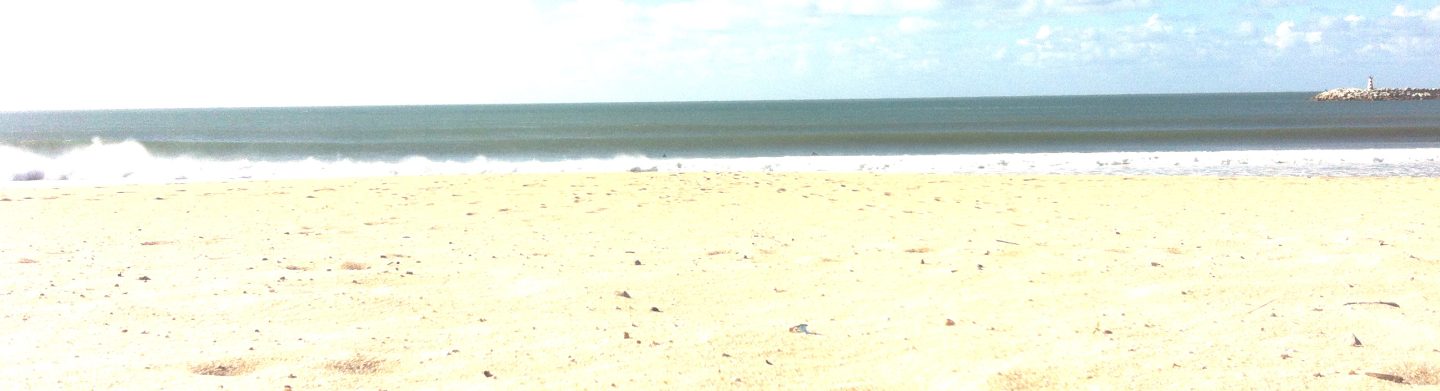
When I watch the surf schools with their ducklings playing in the white wash (the case in the picture above), I remind that what really explains the difference in efficiency in passing through the breaking zone of the waves, between them and a more experienced surfer, is not the physical capacity or mental atitude. Its knowing when to do the right thing.
Because, in reality the movements are simple, and any mismanagement costs time and tires you. If you are not being efficient, each wave takes its toll, you start to delay and you find yourself being pulled back instead of going further.
Again, the pattern here is rhythm. Specifically, knowing

  • when to dive under the wave coming in front of you
  • how deep to dive (the deeper the more effort is spent and more time surfacing again, but going shallow can mean being pulled back)
  • when under the wave, knowing when to point up again to resurface (there is a moment when you can use the rolling motion of the wave to pull you quicker with little effort)

This may seem a lot of detail, but when you are doing something many times (going through waves in this case, or sprinting your project), you multiply those little costs by that number. And in the end, you want to reach the outside and still have energy and attitude to enjoy surfing (or whatever goal you want to achieve).
After more than 11 years at this, I find that the bigger waves allow me more time to relax when resurfacing (the only time when I am motionless) and that, between waves, when the common sense used to tell me to rush in and sprint, I take my time and paddle slowly to breathe calmly and keep energy.
It is rhythm that makes this work efficiently.
I like this situation because it provides a clear and objective assessment of efficiency and the factors that can undermine it. In the end, you either got to the outside and surfed or not. Just that simple.
In project management, less efficiency means more resources spent than those needed. But, as in these examples, we may have clear indicators of performance and giving the adequate time to do the right thing (rhythm or discipline) will result in more efficient use of resources and talent.Once again, it is much more than just speed. 
Just like learning to play a musical instrument, rushing your way won’t get you there so soon.
Try to speed through the breaking waves next time and check that for yourself!

____________
This article was originaly posted on LinkedIn at September 19, 2018.