1. credits to Microsoft for doing serious work on what otherwise is just a mediocre concept of computer intelligence called LLMs.
2. credits to Microsoft for stating today what to me is obvious since back when “AI” was still called big data: «There is absolutely no guarantee that a LLM’s output accurately reflects the source data you’re interested in». Which is reason enough to call a lunatic to anyone using these systems.
3. the reason why it is obvious that LLMs are not reliable, the same as any other statistical approach (including another engineer’s favourite masturbation called “baesian reasoning”), is simple: these systems translate raw real data into a finite, comparatively small set of parameters, therefore they lose information which cannot ever be reconstructed to the original.
4. however this admission comes at least a decade and billions of dollars AFTER these actors have been promoting the fake statistical emulation of intelligence called LLMs; they should be demanded to do better based on the resources they have.
5. As a society we cannot afford to waste such vast resources to deliver billion dollars garbage during 10 years and afterwards start pretending that it is better to clean the garbage instead of doing better scientific research from scratch.
6. so those engineers that have been cheering the next big thing in “AI” should all be labelled as delusional at best and psychotic at worst; totally unfit to perform any duty in exact sciences
7. TWO YEARS AGO I demonstrated how you can analyse large quantities of text in a scientific way, in a deterministic fashion, not probabilistic. This was the basis model for the first proper, scientific reasoning system and it shows how my approach is ahead of the best engineering since years ago.
Now go back to playing with your decade old toys. You are already outdated and each passing day you are thrown further back into the dustbin of History. And I am making sure that you will stay that way.
Transcription by me from the original by Julio Iglesias. My mother introduced me to this gentleman a long time ago and we actually got to attend a show of his here in Lisbon. Julio is awesome!
video: official video clips (excerpts) plus excerpt from “The Legend of 1900” (1998, ‘Playing Love’ scene)
“Scientific” is an attribute of a procedure whose outcome is invariant to its subject. If you let to a unspecified subject to decide the outcome of an experiment, or if you do not state the acceptance criteria beforehand, which includes the conditions under which the experiment is to be performed, then you cannot claim to obtain a scientific result. Therefore, the Turing test as Turing formulated it (1949) has no scientific meaning.
This is basic science that modern “engineers” and “scientists” clearly do not master. If you put a person with a cognitive or knowledge deficit evaluating the Turing test, almost any machine will pass the test. If you train a LLM in a subject beforehand and instruct the evaluator to only ask questions about that domain, the LLM will fare as good if not better than a human. That does not mean that the machine passed the test but that your test cannot achieve its purpose. But this is no different than having a dictionary pass the Turing test while asking it about definitions.
The Turing test means nothing in scientific terms; as it was formulated it is a purely philosophical exercise. [1]
A scientific version of the Turing test is:
have a person who is knowledgeable about a subject domain (the subject) provide novel data in real time to both objects of the experiment and interrogate the objects about that data.
It is important that this subject domain is not specified so it can vary without influencing the validity of the test, meaning it can be any subject and can even change during the same experiment. To pass this test would require for example a machine that learns and reasons in real time, because this is a quality that you know beforehand distinguishes humans from everything else (many animals learn and reason in real time but that is where the subject domain expert comes in the equation).
Despite the fact that no “engineer” and no “scientist” today can explain how such a machine would operate (a direct consequence of the previous statement), it has already been achieved. It is the equivalent of a modern AI system which could not only scientifically reason but do so over an infinite context window. It is the New Approach for True Machine Reasoning and the scientific version of the Turing test is performed in the demo in this video.
In fact the system is so good at learning and reasoning on the fly, that you could only tell the human from the machine in the experiment because the system would not make a single mistake even if you gave it novel information for hours in a row. After a finite amount of time, it would still not fail to provide correct answers but it would become slower than any human, but that is dependent on the hardware of the machine and it would easily happen after it had overflooded the subject’s own capacity to evaluate.
If you really understand how Science works, then you should know that once you have a machine that learns and reasons in real time, then you need an updated acceptance criteria for the Turing test, so you are back to square one and therefore you conclude that no Turing test will ever be able to achieve its own purpose and therefore it is invalid as a scientific tool.
Now, dear “engineers” and “scientists”, its time you get back to doing your “science”. Go back to your favourite college and learn something. Assuming that the fact that you learned nothing about basic Science when you got out of there with a stamped piece of paper and that stupid looking hat on your head does not make this statement a contradiction.
______
[1] I hear a knowledgeable engineer asking “But Turing was an expert, are you saying he was wrong?”, to which I reply “Dear engineer, you cannot take something an expert in the fifties said about a domain new in Science as if he said it today with the current knowledge we have”. Or equivalently, “He may have been right in the fifties but he is wrong today”. Does that sound logical to you dear “engineer”?
I love libraries and I was close to meet Joe Black two times in the past. In one of them I was hit by a car and flew over the tarmac, and on a second occasion I got seriously injured, lost a lot of blood and risked fatal blood cloths. But Joe Black could afford some more time. Just think of millennia multiplied by aeons compounded by time without end. He’s been around that long.
I endorse the current understanding from PMI about the leadership of initiatives in organizations, as characterized in the hybrid Agile/Lean knowledge system designated Disciplined Agile [1], which I expect to quickly become the gold standard in leadership. I am certified in this system, as a Senior Scrum Master, a Value Stream Manager and Enterprise Coach.
In this system, which is the most recent I am aware of, teams do not need to be managed, they need to be led. Teams need leaders not managers.
This applies to any context, but more fittingly to that of the so-called knowledge workers, who by definition have more expertise about their work domain than their leadership.
The role of leadership in organizations is to create good systems in which people work autonomously and self-organized but with minimal governance so as to ensure alignment with the rest of the organization.
This results directly from decades old Lean management principles, the fact being that only in recent years there has been work in translating those principles to fields and industries different than those where Lean originated from (from industrial manufacture into general cognitive work).
The concept of middle-up-down management describes the role of middle management not only in providing visibility about the organization’s strategies and initiatives to the teams implementing them, but also in helping to create the environment in which those teams achieve the vison of leadership.
At a cross-enterprise level, the realization is that traditionally management was focused on managing people, specifically in making sure they were being 100% productive, that is, with maximal utilization. The paradigm shift comes from the realization that the type and flow of work determine the added value much more than the quantity of work. In other words, while people management is top-down and creates silos, work in the organization flows horizontally and below the reporting hierarchies. Therefore, work flow management impacts the organization much more than people management.
As stated by PMI
Leaders are too busy managing the people and no one is managing the flow of value.
While hierarchical management is always a cost, the people’s work is potentially value adding.
This Lean understanding especially fits cross-enterprise initiatives, upper management and executive level, but the principles apply equally to individual programs and projects.
Unlike the traditional Agile empirical control processes (such as Scrum), Lean management is as good for the organization as for the workers because it promotes their autonomy and their alignment with the organization through the creation of good systems where people work in a more efficient manner.
The systems which are the object of Lean management principles also include people, therefore the motivational factor cannot be dismissed. According to Daniel Pink [2], people are motivated by: autonomy, mastery and purpose. These factors are attended to by the before mentioned management principles because those promote people autonomy and skill development, the continuous improvement of skills and the visibility about the organization’s strategies that define the goal and meaning of the initiatives.
The value creation structure — the structure of the teams that produce value together with their span of control and relationships with other teams — and the flow of work (or equivalently, of value) through that structure, are two faces of the same coin and none of them should be dismissed from these considerations.
In short, the management of the relationships between the components of what is a complex adaptive system — a system in which a perfect understanding of the individual parts does not convey an understanding about the whole system’s behaviour — is more important than just trying to sub-optimize individual components.
Besides this, the Lencioni’s model which identifies the five disfunctions of a team with impact on performance, shows us that those disfunctions are a chain of consequences that is triggered by a lack of trust. Therefore, to promote trust between all team members is a fundamental role of leadership.
Another important issue to consider is conflict management. It is necessary for the leadership to appropriately diagnose the levels of conflict so that it can adjust its approach to the context. In this regard it is relevant to note that in Speed Lea’s model of the five levels of conflict, the lowest-level form of conflict which is a honest disagreement about a work subject, is not only normal but also an healthy indicator for team performance. This is also in accordance with the Thomas-Kilman conflict resolution model which advocates a dual approach of assertiveness and collaboration in conflict resolution.
So the leadership ought to:
promote the conditions for workers to perform their job with maximum autonomy
give visibility about the organization’s priorities and about the work and the flow of work
establish minimal governance that ensures alignment in the organization about the creation of value
optimize the relationships between components in the system
promote trust and psychological safety
manage conflicts
promote continuous improvement
An important aspect of leadership is to facilitate the deconstruction of belief systems which may be an obstacle to creativity and people development. In this context, I believe it is much relevant the work of Francis Laleman [5] on what he terms an exformative approach, as opposed to the informative approach of traditional teaching methods.
In what relates to people management, this is a vision of leadership as coaching and not as management.
On another angle, since I have served as an Officer in the military for 6 years, I consider that similarly to the military organization, the role of leadership is to define the best standards and give visibility about them through the behaviour of leaders. In fact, this is one of the means by which organizational culture is created and transmitted, and therefore one of the factors to attend to for the success of enterprise transformation initiatives.
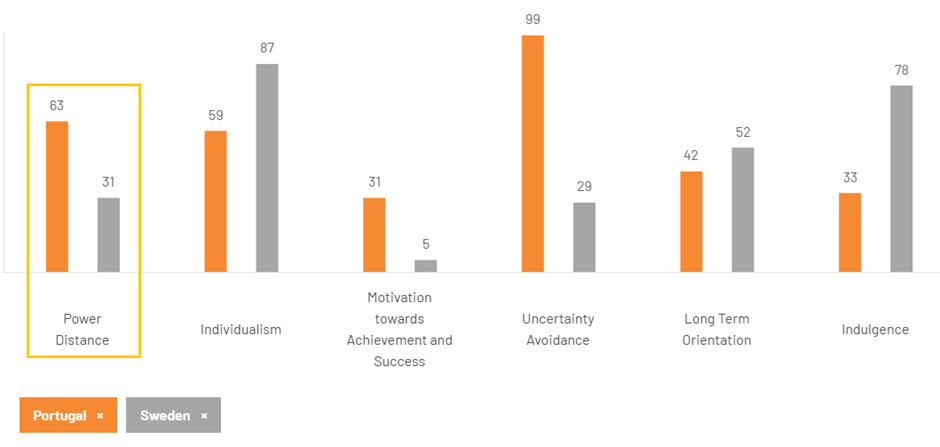
Hofstede Insights [6] provides a comparative analysis of different cultures in several dimensions, and in particular there is one that sets the Portuguese culture apart from others in Northern Europe. It is called “power distance” and it pertains to how hierarchical leadership is perceived and exercised. In the Portuguese case it is described as follows.
Portugal’s score on this dimension reflects that hierarchical distance is accepted and those holding the most powerful positions are admitted to have privileges for their position. Management controls, i.e. the boss requires information from his subordinates and these expect their boss to control them. A lack of interest towards a subordinate would mean this one is not relevant in the Organization. At the same time, this would make the employee feel unmotivated. Negative feedback is very distressed so for the employee it is more than difficult to provide his boss with negative information. The boss needs to be conscious of this difficulty and search for little signals in order to discover the real problems and avoid becoming relevant.
For comparison, we have the example of Portugal and Sweden:
In the Swedish culture power distance is described as follows:
The following characterises the Swedish style: Being independent, hierarchy for convenience only, equal rights, superiors accessible, coaching leader, management facilitates and empowers. Power is decentralized and managers count on the experience of their team members. Employees expect to be consulted. Control is disliked and attitude towards managers are informal and on first name basis. Communication is direct and participative.
With regards to improvement and change management, it is important to consider that
people do not resist change as much as they resist imposed change [3]
people change less because they were given an analysis that influences their way of thinking than because they were presented with an evidence that changes their way of feeling [4]
the way people are evaluated affects their behaviour
According to Weatley and Kellner-Rogers [3]
All systems do insist in exercising their own creativity. They never accept imposed solutions.
Group resistance is not more about change than it is about imposed change, instead of creation of change. Moreover, according to Bruce Tuckman, if the leader needs to direct the team’s behaviour then that team is at the lowest maturity level in a scale that ends up in a high performing team.
In this sense, even a beneficial change may not be accepted if imposed by leadership or if presented as a promotion of an individual initiative.
In group leadership it is important to exercise care when choosing the motivation and reward mechanisms, lest we turn team endeavours into individualistic entrepeneurship. An example of this are individual bonuses negotiated with the leadership. The focus should be in the team performance more than individuals’, both regarding the motivation strategy and the metrics selection for performance assessment.
I can provide two examples form my experience. On one case, I had a client that was rewarding individuals for annual performance, but they arrived at the conclusion that it were always the same people that were rewarded which demotivated others. To work around this they decided to rotate the reward, meaning that no same person could be rewarded twice in a row. However, this gave no reason for the highest performers to keep their performance. This is one example of the problems of rewarding individuals as opposed to teams.
Another case was confided to me by a co-worker who told me that in his previous assignment there were these managers fiercely competing between themselves for the annual bonuses. This obviously meant that their personal gain was put above their team’s when decisions had to be made during the year. This does not benefit the organization, quite the contrary.
One aspect that can facilitate continuous improvement is the Lean technique of standard work. Standard work is not a static procedure that has to be followed forever. Instead, it is a reference against which we can identify variations in approach and those that prove to be better should be adopted and become the new standard work, thus setting the baseline for future improvement. In this way change is promoted as something natural and part of the work processes of the team.
What are the main qualities of leadership?
Following previous statements, a leader should exhibit the qualities compatible with effective change and people management:
empathy and active listening
communication
growth mindset
trust
respect for people
knowledge of good organizational development practices
coaching (people development practices)
pragmatism (action over planning; judicious use of processes)
delegation (of work and responsibility)
systems thinking
people motivation
conflict management
This applies not only towards leadership but also to the individual team members, since change should not be imposed but instead be organic.
What leadership profiles can we find?
The leadership profile can assume different shapes depending on how it positions itself in the continuum of several dimensions, regarding which the most relevant will be:
Another logical argument in favour of the resonance on a universal crystalline structure can be provided as follows. This adds to the prior analysis available here.
Let A and B be two events in different moments in time. If A implies B, that is if we have B whenever we have A, then B asserts the verification of A. Therefore, A cannot have happened after B given that B happened. Therefore, we say that A causes B. But if A and B happen in different moments in time, which is an assumption for the causality relation, then when B happens A already happened. Therefore, when B happens there is nothing happening that can cause B, which is a contradiction [1]. Therefore, if B happened then some information regarding A was propagated in a fractional time between A and B happening. And this propagation has to happen in a medium or dimension that is foreign to time, otherwise the causality A => B would be restrict to time leading to the contradiction [1].
This is the same concept as that of the resonance that I have already explored before, that is, A causes B as much as B causes A, and the medium in which the causality takes effect, a medium foreign to time, can only be a subset of the crystalline structure of the Universe, since it is time invariant. Equivalently, causality and retroactivity are two aspects of the same mechanism, which we refer to by the concept of “resonance” on a necessarily time-invariant medium. As stated elsewhere, this explains why events in the Universe follow a given path while not leaving the evidences of all the trial of possibilities that should be the case had a (time-dependent) causality (but not a resonance) taken place.
For example, biological systems developed light capturing devices (the eyes) because there is visible light, but equivalently visible light exists because something is affected by it. Both are evidences of the same mechanism, action or property. And there is no evidence that biological systems had developed sensing to the entire range of light spectrum which had been selectively “pruned” by natural selection to just a specific range of frequencies. Therefore, the “choice” of the method for sensing light was the same “choice” for the existence of light. Here we say “choice” to mean a time-invariant mechanism, or the concept of a “resonance” on a time-invariant medium.
This explains why species evolved in a specific way while we could never find all the intermediate fossil forms and wide-raging branches that evolution should have produced if Darwin’s assumptions were true. The same for the number of arms or legs, for the symmetry of biological systems, for the arrangement of electrons in atoms and so on.
Everything that exists or happens is therefore a manifestation of the same crystalline, immutable universal geometry. And the interesting thing about it is that it should be possible to infer the properties of such a structure by its manifestations.
This is, again, consistent with non-dual postulates such as
What you seek is seeking you
You already are what you will become
Moreover, the parallel universes theory of physics is an application of these principles, since the possibilities for the state of a system spread throughout the parallel dimensions, the collection of those becoming the universal geometric structure.

 Compliments of the Author