This article follows the introduction to the piano for beginners available here.
Lets look at page 1 of Goodman’s book about abstract algebra (version 2.6).
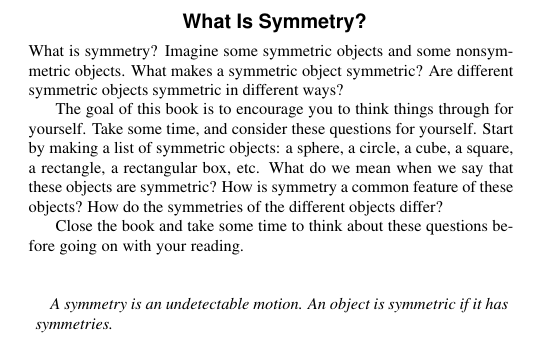
He defines symmetry as an “undetectable motion”.
There are two components to this. One is the motion, or the action, an event or transformation that takes place. This transformation can include the identity transformation if you accept that changing nothing is also an action. The other component is the fact that this transformation changes nothing in the state of the object upon which it acts. The end state is the same as the initial state, therefore you cannot tell that the action took place just by looking at the outcomes.
In this sense, a symmetry is doing something while doing nothing.
For our purposes here, we generalize the definition to the change and the preservation of any property of the system under study.
That is, a symmetry is a change on a property of the system that leaves another property invariant (unchanged).
We will naturally be applying the definition to the system of the piano musical notes.
Without needing to objectively define music, we can define at least one of the attributes that distinguishes it from every other sequence of sounds. And that is a presence of a structure, or equivalently, an order.
Music is a variation over a structure. For example, the difference between talking and singing is the symmetric structure of the latter.
Using symmetries is one way of facilitating the creative process in music.
More specifically, we have two components in the system which can be acted upon by symmetries:
- structure, that is, the choice of notes used
- function or operation, that is, any relationship that can be established between the elements in the structure (notes)
Something we can therefore establish from the start is that whenever we have a symmetry we have a structure, and vice-versa. These are intermutable concepts.
By definition, whenever we have music we have a structure, therefore to talk about music is to talk about symmetries.
It is important to have this logical mapping in mind because, as those who are familiar with mathematics already know, we can study any system in place of another that we are inquiring about as long as we can establish a “faithful” relationship between those two systems.
In our case here, we address the system of music using the system of symmetries, and due to this we are in fact acting upon and talking about the same exact thing. This also means that it is irrelevant whether a composer actually thought about symmetries while composing (most probably he didn’t).
It is also important to make it clear that a symmetry is not a pattern. A pattern is focused on the outcome, while a symmetry is focused on an action, therefore on the creation. Example of a symmetry: a rotation of a square on the 2D plane by 90 degrees around its center.
We can classify the symmetries we are interested in based on whether the structure or the operation are fixed:
- if both are fixed then nothing changes; this is the identity transformation which for our purposes here is not a meaningful symmetry (but it is a necessary member of symmetry groups in mathematics)
- if only structure changes, we have a structural symmetry, that is, the same relationship between notes; in this case the action is the structure, that is, the choice of notes, and their relationship is invariant
ex: A B C D - if only the operation changes, we have a functional symmetry; in this case the notes do not change and therefore the only allowed operation is the choice of octaves. This is the same note played in different octaves.
- if both change, the symmetry can be one of them or both depending on what can be fixed
ex: A C B D… which can have as invariant the relationships 2, -1, 2, -1, etc
Because the operation or relationship is relative to a structure, we can start the creative process by a choice of structure. We create or choose a structure that defines an operation such that the pair is a symmetry.
In this case structure induces symmetry which in turn induces new structure. And this is the creative process based on the concept of simmetry.
ex 1. create a structure from scratch:
A C B D (example for case 4 above)
ex 2. take an existing structure A A B A A C, define a structure over it and create a new symmetric structure
2.1. (A A (B))(A A (C)) —> (A A (B))(A A (C)) + (A A (D))
2.2. (A (A B A))(A (C —> (A (A B A))(A (C + D C))(A (E F E))
Improving an existing structure and creating a structure which can be improved are of course two different things.
Some people struggle with just one of those. Symmetries allow to unlock the capability to create a structure upon which to improve.
It is an architecture of general creation.
Different instruments favour different symmetries. This is in essence what makes music different between instruments.
We may start with an objective intention about what we wish to portray in musical language, but until the creation is done there always is a stage of exploration.
By defining symmetries and variations of them we can evolve that structure until we find a resonance, that is, a unified structural “soundness”.
A resonance in this context is an identity of a system. A system can have different resonances and it should be useful to study their relative properties, namely whether a particular resonance should be considered the unique identity of a system, in which case probably this system would be perfectly described.
For our purposes here any resonance suffices in signaling we achieved our desired end — we created a new musical piece.
The difference between a composer in the classical sense and other people is not in the sensibility or imagination but in the knowledge of applicable symmetries.
This is what is most impacted and favoured by experience, and therefore it is not determined by innate ability and can be developed.
Classical composers had visions and feelings and inclinations just like you do. They knew how to use a musical instrument just like you do. But what you lack that they developed to a high degree is the understanding of the musical symmetries, because those processes codify musical creation itself.
This knowledge is precisely what is neglected by an obssessive focus on performance that is incurred by the totality of acclaimed piano players.
Thus ironically, those who pursue a pure understanding of the composers they study, actually miss their essencial quality — the range of symmetric tools and transformations that they developed and that lie at the genesis of all of their creations.
This is something that can be reproduced faithfully by anyone, but here also we do not benefit from imitation.
There is no point in creating music like someone else used to do.
Creation has nothing in common with pure reproduction.
Is it a worthy reward to have worked so hard to play a musical instrument just to end up a trained monkey on a craft?
Reward yourself by creating instead. That is what is worthy of you.
As I explained elsewhere, this “systematic” creative process is in fact the only thing that has ever happened.
As a final remark, I can be somewhat bothered by the instrumentalization of the ideas here developed, namely by artificial replacements of human creativity, but I wish to see it as one more strong argument for the necessity of humans claiming possession of these tools.
Otherwise there cannot be a leveled playing field, that is a human playing field.
So claim it for yourself.
You can watch the video on Rumble.
Header image by Lulwah Al Hamoud, Barjeel Art Foundation.


One thought on “Symmetry in musical creation”
Comments are closed.