What is the role of leadership?
I endorse the current understanding from PMI about the leadership of initiatives in organizations, as characterized in the hybrid Agile/Lean knowledge system designated Disciplined Agile [1], which I expect to quickly become the gold standard in leadership. I am certified in this system, as a Senior Scrum Master, a Value Stream Manager and Enterprise Coach.
In this system, which is the most recent I am aware of, teams do not need to be managed, they need to be led. Teams need leaders not managers.
This applies to any context, but more fittingly to that of the so-called knowledge workers, who by definition have more expertise about their work domain than their leadership.
The role of leadership in organizations is to create good systems in which people work autonomously and self-organized but with minimal governance so as to ensure alignment with the rest of the organization.
This results directly from decades old Lean management principles, the fact being that only in recent years there has been work in translating those principles to fields and industries different than those where Lean originated from (from industrial manufacture into general cognitive work).
The concept of middle-up-down management describes the role of middle management not only in providing visibility about the organization’s strategies and initiatives to the teams implementing them, but also in helping to create the environment in which those teams achieve the vison of leadership.
At a cross-enterprise level, the realization is that traditionally management was focused on managing people, specifically in making sure they were being 100% productive, that is, with maximal utilization. The paradigm shift comes from the realization that the type and flow of work determine the added value much more than the quantity of work. In other words, while people management is top-down and creates silos, work in the organization flows horizontally and below the reporting hierarchies. Therefore, work flow management impacts the organization much more than people management.
As stated by PMI
Leaders are too busy managing the people and no one is managing the flow of value.
While hierarchical management is always a cost, the people’s work is potentially value adding.
This Lean understanding especially fits cross-enterprise initiatives, upper management and executive level, but the principles apply equally to individual programs and projects.
Unlike the traditional Agile empirical control processes (such as Scrum), Lean management is as good for the organization as for the workers because it promotes their autonomy and their alignment with the organization through the creation of good systems where people work in a more efficient manner.
The systems which are the object of Lean management principles also include people, therefore the motivational factor cannot be dismissed. According to Daniel Pink [2], people are motivated by: autonomy, mastery and purpose. These factors are attended to by the before mentioned management principles because those promote people autonomy and skill development, the continuous improvement of skills and the visibility about the organization’s strategies that define the goal and meaning of the initiatives.
The value creation structure — the structure of the teams that produce value together with their span of control and relationships with other teams — and the flow of work (or equivalently, of value) through that structure, are two faces of the same coin and none of them should be dismissed from these considerations.
In short, the management of the relationships between the components of what is a complex adaptive system — a system in which a perfect understanding of the individual parts does not convey an understanding about the whole system’s behaviour — is more important than just trying to sub-optimize individual components.
Besides this, the Lencioni’s model which identifies the five disfunctions of a team with impact on performance, shows us that those disfunctions are a chain of consequences that is triggered by a lack of trust. Therefore, to promote trust between all team members is a fundamental role of leadership.
Another important issue to consider is conflict management. It is necessary for the leadership to appropriately diagnose the levels of conflict so that it can adjust its approach to the context. In this regard it is relevant to note that in Speed Lea’s model of the five levels of conflict, the lowest-level form of conflict which is a honest disagreement about a work subject, is not only normal but also an healthy indicator for team performance. This is also in accordance with the Thomas-Kilman conflict resolution model which advocates a dual approach of assertiveness and collaboration in conflict resolution.
So the leadership ought to:
- promote the conditions for workers to perform their job with maximum autonomy
- give visibility about the organization’s priorities and about the work and the flow of work
- establish minimal governance that ensures alignment in the organization about the creation of value
- optimize the relationships between components in the system
- promote trust and psychological safety
- manage conflicts
- promote continuous improvement
An important aspect of leadership is to facilitate the deconstruction of belief systems which may be an obstacle to creativity and people development. In this context, I believe it is much relevant the work of Francis Laleman [5] on what he terms an exformative approach, as opposed to the informative approach of traditional teaching methods.
In what relates to people management, this is a vision of leadership as coaching and not as management.
On another angle, since I have served as an Officer in the military for 6 years, I consider that similarly to the military organization, the role of leadership is to define the best standards and give visibility about them through the behaviour of leaders. In fact, this is one of the means by which organizational culture is created and transmitted, and therefore one of the factors to attend to for the success of enterprise transformation initiatives.
Hofstede Insights [6] provides a comparative analysis of different cultures in several dimensions, and in particular there is one that sets the Portuguese culture apart from others in Northern Europe. It is called “power distance” and it pertains to how hierarchical leadership is perceived and exercised. In the Portuguese case it is described as follows.
Portugal’s score on this dimension reflects that hierarchical distance is accepted and those holding the most powerful positions are admitted to have privileges for their position. Management controls, i.e. the boss requires information from his subordinates and these expect their boss to control them. A lack of interest towards a subordinate would mean this one is not relevant in the Organization. At the same time, this would make the employee feel unmotivated. Negative feedback is very distressed so for the employee it is more than difficult to provide his boss with negative information. The boss needs to be conscious of this difficulty and search for little signals in order to discover the real problems and avoid becoming relevant.
For comparison, we have the example of Portugal and Sweden:
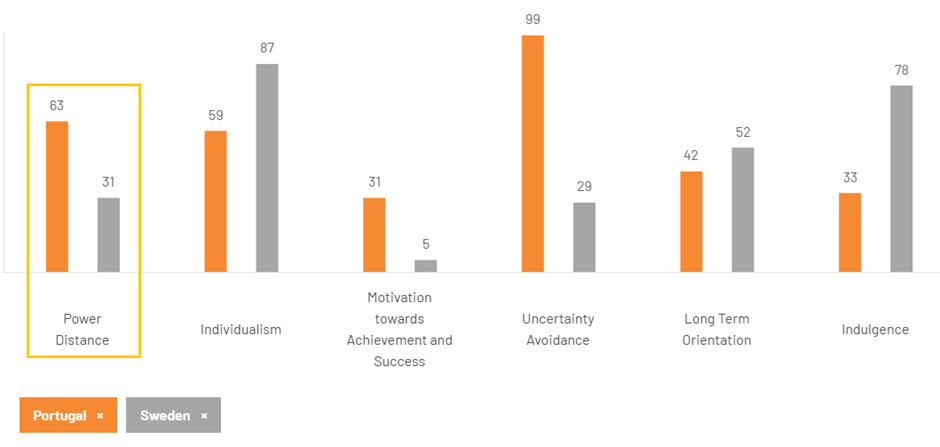
In the Swedish culture power distance is described as follows:
The following characterises the Swedish style: Being independent, hierarchy for convenience only, equal rights, superiors accessible, coaching leader, management facilitates and empowers. Power is decentralized and managers count on the experience of their team members. Employees expect to be consulted. Control is disliked and attitude towards managers are informal and on first name basis. Communication is direct and participative.
With regards to improvement and change management, it is important to consider that
- people do not resist change as much as they resist imposed change [3]
- people change less because they were given an analysis that influences their way of thinking than because they were presented with an evidence that changes their way of feeling [4]
- the way people are evaluated affects their behaviour
According to Weatley and Kellner-Rogers [3]
All systems do insist in exercising their own creativity. They never accept imposed solutions.
Group resistance is not more about change than it is about imposed change, instead of creation of change. Moreover, according to Bruce Tuckman, if the leader needs to direct the team’s behaviour then that team is at the lowest maturity level in a scale that ends up in a high performing team.
In this sense, even a beneficial change may not be accepted if imposed by leadership or if presented as a promotion of an individual initiative.
In group leadership it is important to exercise care when choosing the motivation and reward mechanisms, lest we turn team endeavours into individualistic entrepeneurship. An example of this are individual bonuses negotiated with the leadership. The focus should be in the team performance more than individuals’, both regarding the motivation strategy and the metrics selection for performance assessment.
I can provide two examples form my experience. On one case, I had a client that was rewarding individuals for annual performance, but they arrived at the conclusion that it were always the same people that were rewarded which demotivated others. To work around this they decided to rotate the reward, meaning that no same person could be rewarded twice in a row. However, this gave no reason for the highest performers to keep their performance. This is one example of the problems of rewarding individuals as opposed to teams.
Another case was confided to me by a co-worker who told me that in his previous assignment there were these managers fiercely competing between themselves for the annual bonuses. This obviously meant that their personal gain was put above their team’s when decisions had to be made during the year. This does not benefit the organization, quite the contrary.
One aspect that can facilitate continuous improvement is the Lean technique of standard work. Standard work is not a static procedure that has to be followed forever. Instead, it is a reference against which we can identify variations in approach and those that prove to be better should be adopted and become the new standard work, thus setting the baseline for future improvement. In this way change is promoted as something natural and part of the work processes of the team.
What are the main qualities of leadership?
Following previous statements, a leader should exhibit the qualities compatible with effective change and people management:
- empathy and active listening
- communication
- growth mindset
- trust
- respect for people
- knowledge of good organizational development practices
- coaching (people development practices)
- pragmatism (action over planning; judicious use of processes)
- delegation (of work and responsibility)
- systems thinking
- people motivation
- conflict management
This applies not only towards leadership but also to the individual team members, since change should not be imposed but instead be organic.
What leadership profiles can we find?
The leadership profile can assume different shapes depending on how it positions itself in the continuum of several dimensions, regarding which the most relevant will be:
- directivity vs delegation
- organization vs individual
- innovation vs established processes
- individual vs flow of work
- value vs cost
- components vs relationships between components
- work visibility vs invisibility
- planning vs execution
- collaboration vs assertiveness
- speed vs removing roadblocks
- cost of work vs cost of inefficiency
_________
[2] Daniel Pink, “Drive: The Surprising Truth About What Motivates Us”, 2011
[3] Weatley and Kellner-Rogers, “A Simpler Way”
[4] Kottler, J.P. & Cohen, D.S., “The Heart of Change: Real-life stories of how people change their organizations”, 2012
 Compliments of the Author