The process of developing new skills while we are already mature enough to assess that development itself may lend to an infinite loop of added value. You are challenged. You adjust yourself. You explore the challenge by relating it with previous experiences. You map the universe you know to the new reality.
The effort is crowned when you discover what it means to have learned something new towards other dimensions in which you are still developing.
What can this mean in the context of ______?
What have I learned about this that can help me navigate ______?
This article illustrates this point – that you can exponentialize your learning by assessing your learning process itself and by devising its potential applications.
Leading with the right hand
The right hand sets and keeps the strings in motion by passing the bow hairs over them. Because the hairs are powdered with rosin, this friction energizes the strings. Each string will vibrate at a specific frequency at any given situation, depending on the tension at rest, the vibrating length and type of string (each string is different in the way it is built or the material used).
In what concerns the right hand, this frequency is not determined by the violinist.
In the most simple case, in which we do not want to add ornaments to the notes (intensity, tonality, chromatism, etc, which we collectively term embelishments), the role of the right hand relative to the string being played is merely to set it in motion and keep it doing so for the duration of the note. Because we want the natural sound, we want to let the strings vibrate at their natural frequency.
The right hand will be imposing nothing more on the string than merely the mimimum friction to keep it vibrating.
Anything else we add to this, relative to the string, will change its natural sound; it will either be an ornament or a deviation from the intended sound.
Its also up to the right hand to choose the string being played.
These two roles mean that the right hand will be changing its position to set the bow angle to tackle the right string, and it will be varying speed depending on the time value of each note. Regarding the angle of the bow relative to the violin, there is a very limited degree of freedom between adjacent strings, and transitioning between non-adjacent strings requires a precise knowledge about this range a priori.
Changes in speed of the bow are especially relevant when also changing direction of stroke or crossing strings, in which case a similar situation occurs as when starting the first note (at the beggining of the music or after a pause).
Start with the miminum effort to set the strings in motion and only right after concern yourself with setting the right speed of the bow.
For this you start by moving not your arm, but just your fingers or in an even smallest degree your wrist.
So there are two key attributes of the right hand leadership at play here, which it is very easy to conflict with each other when learning:
- precision
- smoothness
You know precisely what your movements will be just before executing them, but that intentionality and precision are put in place with the minimum stress on the strings.
I use mental frames to set me up for doing things in specific ways, such as in this case. I picture my hand resting on the bow at all times, not commanding it. To get a notion of what it is, rest your forearm in some surface where your hand and wrist will be free to move. You hand will drop below the line of your forearm and your fingers will be slightly curved towards your thumb.Now place a pencil between the thumb and the other fingers, grab it with the tips of your fingers and they will almost exactly land in the usual relative positions violinists hold the bow.

The most confortable, natural and effortless disposition will produce the best approximation to the proverbial “pure and singing tone”.
This is a principle that guides formal composition and transcription as well, because there are countless ways a given sequence of notes can be played, and all decisions in this respect should place the musician in the most natural position for execution:
- the notes can be played in separate dedicated bow strokes or in the same one (legato);
- the same note can be played in different strings (with different fingerings);
- the difficulty of added ornaments may depend on combinations of the previous two factors.
Leading with the left hand
The left hand sets the vibrating length of the strings, by pressing them with the fingertips against the fingerboard, which in turn determines the exact frequency of the sound produced when playing, along with the tension of the string at rest and the type of string.
The key attributes of the left hand leadership are
- strenght
- anticipation
The finger has to fix the extremity of the vibrating string acting like a small hammer for the duration of the note. Less pressure than that will slow the intended frequency of the note for allowing more freedom of movement to the string and will sound the same as a muffled lower pitch note.

This attribute of the left hand contrasts with the right hand, as you may have noticed already, and that is an added difficulty when learning because the two hands behave very differently but in precise concert with each other.
As for the anticipation, it is two-fold
- The left hand executes before the right hand
- The available left fingers anticipate the next notes
This means that the bow plays on a string which is already stopped by a left hand finger and that, while playing a note, the next notes should be anticipated whenever possible so that this principle is applied for two consecutive notes. That is, while playing a given note, if the next fingers you will be using are available, place them over the strings before you need them. This may lead you to play on a finger while having up to three other fingers already in place (most probable if the notes are very short in duration). This in turn will allow you to focus more on the bow between notes, which is specifically useful when crossing strings.
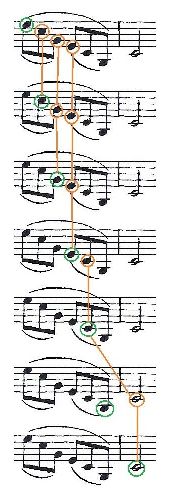
In this image you can see the same sequence of notes in time, the notes stopped already by the left hand fingers in waiting (orange) while the green note is being played.
Without the left hand leadership, a melody is played in a succession of disconnected individual notes, and these will start with a delay between them making the start pitch of the note always lower than its final one. On the opposite, provided that all other factors are adequately accounted for, the 2nd dimension is what glues everything together into a natural performance, much like water flowing in a stream, because
it sets the stage for reducing the overall effort of playing.
So there you have it:
- precision
- smoothness
- strenght
- anticipation
Alexander Markov’s beautiful performance puts it all together in this excerpt ending with a timely advice on the subject [1].
[1] Alexander Markov plays Paganini’s 24th Caprice, an excerpt from ref [2], and talks about violin practice from ref [3]
[2] https://www.youtube.com/watch?v3DaGGPEDWQA5A
[3] https://www.youtube.com/watch?v3DNSoWTWXoIwY
____________
This article was originaly published on LinkedIn at August 10, 2021.
 Compliments of the Author